
27 Japanese Zen Garden Ideas That Transform Any Backyard Into a Peaceful Retreat

Most backyards get designed once and then forgotten. A corner that never quite works. A strip of lawn that nobody uses. A patio that feels more like a parking lot than a place to sit and breathe. Japanese zen garden ideas fix that, not by adding more, but by stripping things back to what actually matters: stone, gravel, water, moss, and silence.
The karesansui tradition, dry landscape gardening rooted in Zen Buddhist temples of Kyoto’s Muromachi period, has been guiding Japanese garden designers for over a thousand years. What makes it so adaptable for modern homes is the philosophy underneath it: asymmetry over symmetry, natural materials over ornament, stillness over noise. You don’t need a large yard or a large budget. You need intention.
These 27 Japanese zen garden ideas cover every scale and style, from compact side-yard gravel gardens to full backyard transformations with koi ponds and stone pathways. Each idea includes design logic, practical implementation tips, and honest budget guidance so you can choose what fits your space and your life.
1. Classic Raked Gravel Karesansui
The raked gravel garden is the most recognized form of Japanese zen garden design, and for good reason. A bed of finely crushed white or grey gravel, raked into ripple patterns around carefully placed boulders, creates the visual impression of water in motion without a single drop. Light catches differently across the surface at dawn and dusk, making the garden change character through the day.
Gravel works better than sand in most home gardens because it holds its patterns longer and resists wind disturbance. Use a fine-toothed metal rake to smooth, then a wide-toothed wooden or bamboo rake to draw the patterns. Common patterns include concentric circles around stones (representing water ripples), parallel lines (a flowing stream or frozen winter field), and interlocking wave forms. The act of raking is itself meditative, and many homeowners find they rake the garden three or four times a week simply because it feels good.
Pea gravel, crushed granite, or decomposed quartz in white, cream, or light grey work best. Aim for a depth of 2 to 4 inches over a weed-suppressing landscape fabric base. Budget: low, $150 to $400 depending on area size.

2. Moss Carpet as Ground Cover
Moss has been a defining material in Japanese garden design for centuries, and it makes a compelling alternative to gravel in shadier areas where raked patterns aren’t practical. A thick, emerald carpet of moss over flat ground creates a lush, quiet softness that contrasts beautifully with stone.
The most useful moss types for garden ground cover include cushion moss (Leucobryum glaucum), sheet moss (Hypnum), and star moss (Tortula ruralis). All prefer partial to full shade, consistent moisture, and slightly acidic soil. Moss establishes slowly but requires almost no maintenance once settled: no mowing, no fertilizing, and very little weeding once the canopy closes.
Pair moss ground cover with rounded stepping stones or large flat slabs to create movement through the space without disturbing the visual calm. Moss also works well around the base of specimen trees, named zen traditions describe the moss garden as a living embodiment of wabi, the beauty found in imperfection and age. Budget: low to mid, $100 to $350 for transplants or spores.

3. Stone Lantern as a Focal Point
The tōrō stone lantern is one of the oldest and most recognizable elements of Japanese garden design. Originally placed at Buddhist temples to light pathways for worshippers, lanterns moved into residential gardens during the tea garden tradition of the 16th and 17th centuries. In a home zen garden, a single well-placed lantern draws the eye, anchors a corner, and gives the space a point of spiritual weight.
Granite lanterns are the most authentic and durable option, aging beautifully with moss and lichen over time. Concrete lanterns cost considerably less and look convincing within a few seasons once weathering sets in. Resin versions are lightest and most affordable but can look synthetic unless placed carefully among natural materials.
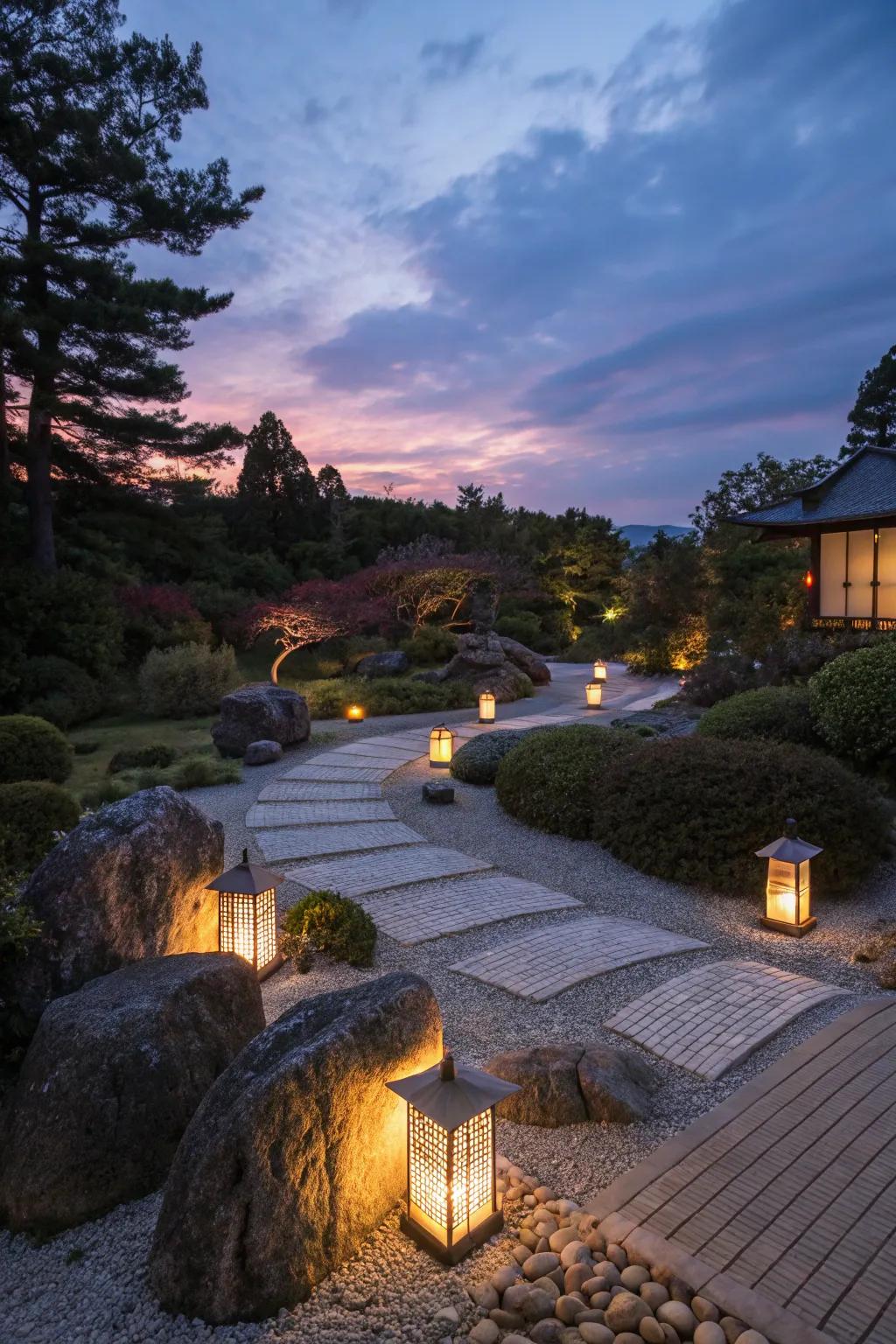
The best placement is near a water feature, at the end of a stepping stone path, or framed by low bamboo or clipped azaleas. Battery-operated candles inside the lantern create a warm glow at night without any electrical work. Budget: low to high, $80 for concrete to $600 for natural granite.
4. Bamboo Privacy Screen
Privacy is a practical concern in most backyards, and bamboo handles it with an authenticity that vinyl or timber fencing simply can’t match. A bamboo screen or fence creates a soft, natural wall that moves gently in the breeze, filters afternoon light, and provides the sense of enclosure that makes a zen garden feel like a separate world from the rest of the property.
The most common approach is to sink treated lodge poles into the ground at regular intervals and secure panels of split bamboo or whole bamboo culms between them. Heights between 5 and 7 feet work well for most garden rooms. Clumping bamboo varieties like Fargesia or Bambusa can also be planted as a living screen, though they take two to three seasons to reach screening height.
Pair bamboo screening with a flagstone pathway running along the inner face to reinforce the sense of a defined, intentional garden room. Budget: mid, $200 to $600 for a 10 to 15 foot section.
5. Winding Stepping Stone Pathway
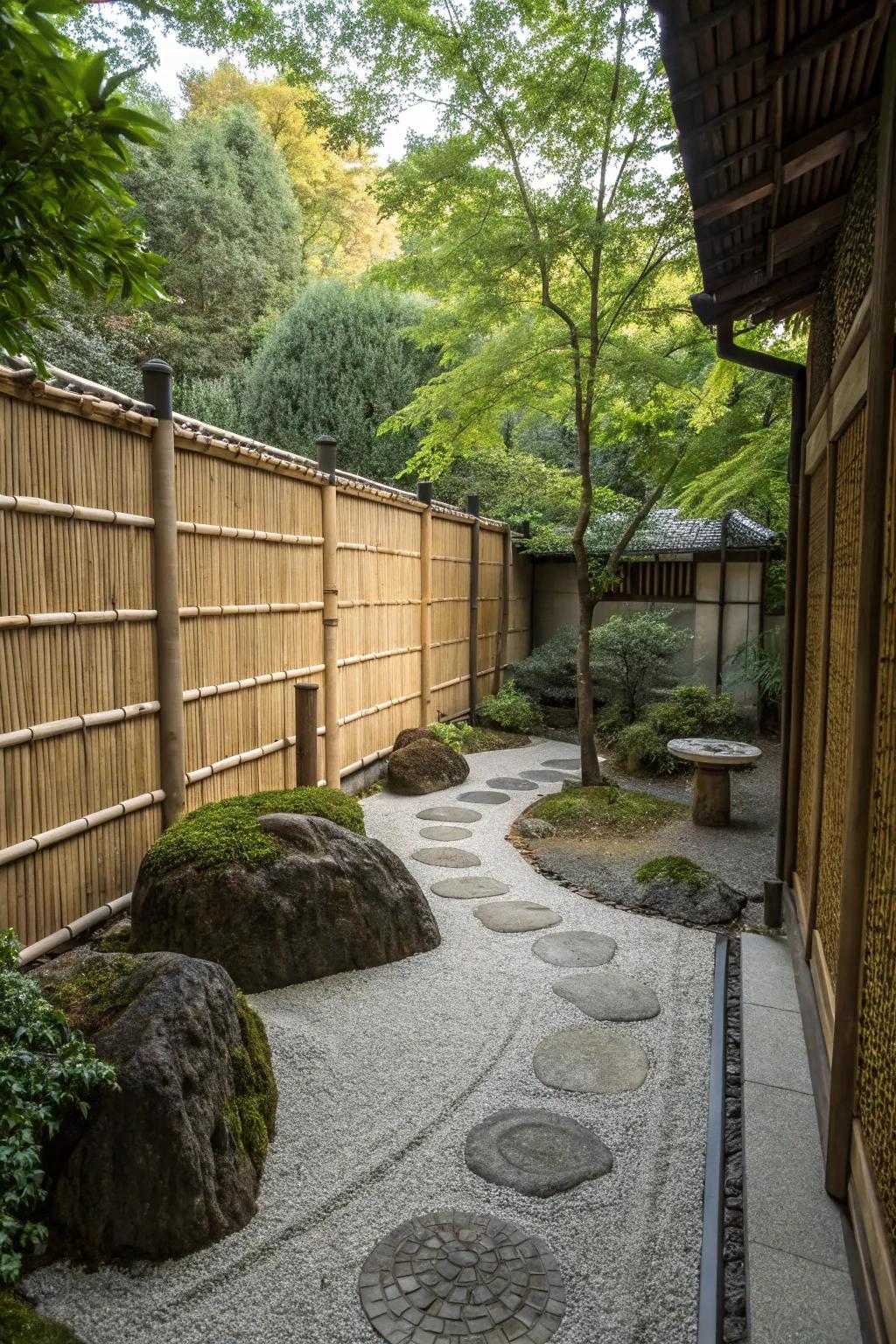
A pathway through a zen garden serves two purposes: it guides movement and it controls pace. A straight path moves people quickly. A winding path through irregular stepping stones forces a slower step, a downward gaze, a more deliberate awareness of the ground underfoot. This is precisely the effect traditional Japanese garden designers intended.
Use flat natural stones like local fieldstone, bluestone, or irregular slate, set into gravel or moss at comfortable stride intervals, typically 18 to 22 inches center to center. Setting each stone a few inches into the ground makes them look naturally embedded rather than placed on top. Odd-numbered stone groupings and intentional slight curves read as more natural than straight lines.
A well-designed stone path through raked gravel is one of the most visually compelling features a zen garden can have, linking elements while preserving the clean lines of the overall composition. The names meaning water in Japanese often reference the winding nature of streams, the same visual logic that informs a curving garden path. Budget: low to mid, $200 to $500 for a simple 15-foot path.
6. Japanese Maple as Anchor Tree
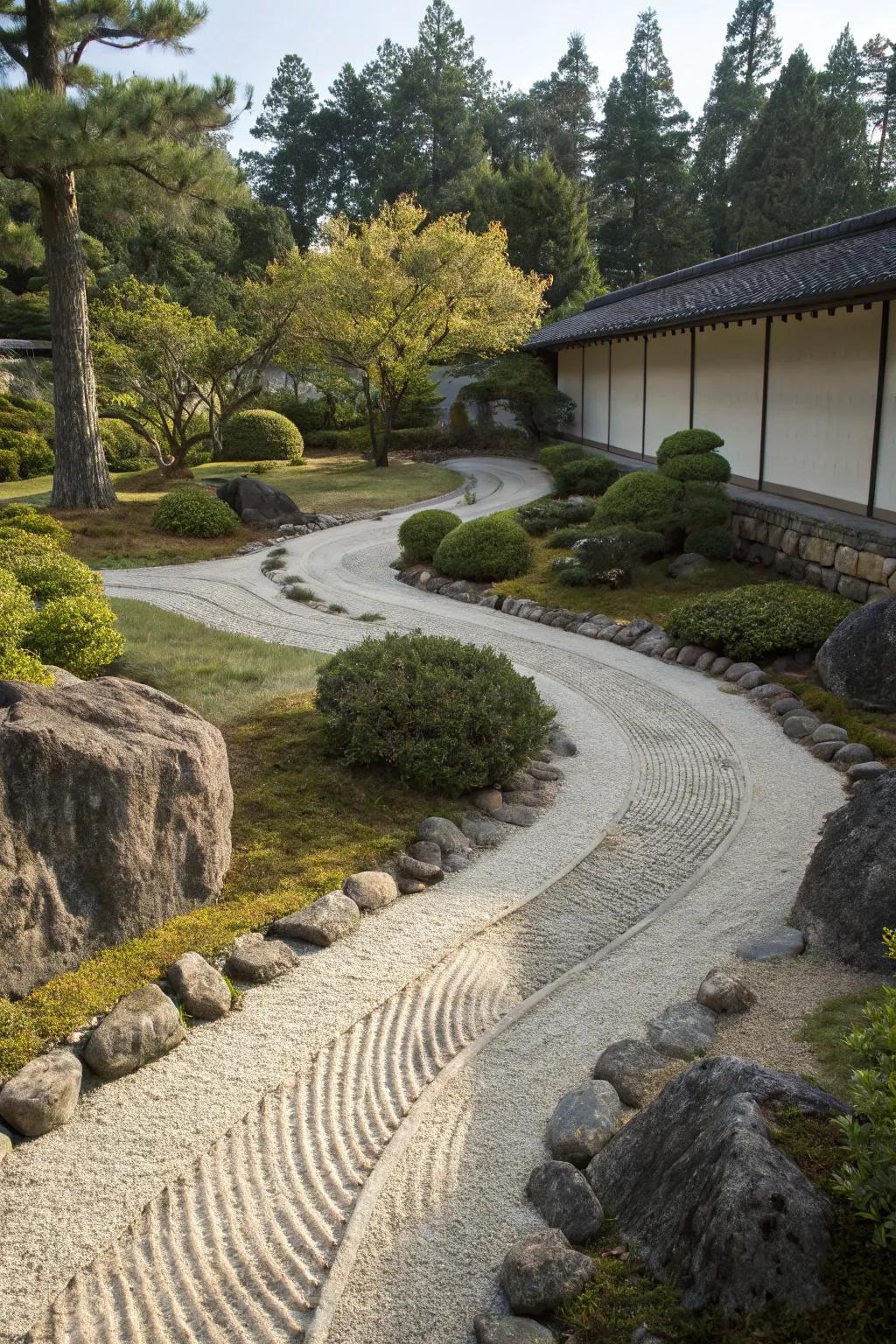
No tree communicates the Japanese garden aesthetic more immediately than Acer palmatum, the Japanese maple. Its layered branching structure, delicate leaf texture, and dramatic seasonal color changes from spring green to deep autumn red make it the perfect specimen tree for a zen garden. Planted as the primary anchor element, a Japanese maple gives the space a living focal point that changes character through every season.
Weeping varieties like ‘Crimson Queen’ and ‘Tamukeyama’ suit smaller spaces and create a canopy effect over gravel or moss. Upright varieties like ‘Bloodgood’ work well as a single backdrop tree behind a gravel composition. All varieties prefer partial shade, moist well-drained soil, and protection from hot afternoon sun and strong wind.
Place the tree asymmetrically within the garden frame, not centered, following the Japanese design principle of fukinsei. A single boulder at the base grounds the composition. Budget: mid to high, $60 for a 1-gallon starter to $300 or more for a mature specimen.

7. Koi Pond Water Feature
Water is the one element that makes a zen garden fully come alive as a sensory experience. The sound of moving water from a recirculating pump or small cascade changes the acoustic character of an outdoor space in ways that no other garden feature can replicate. Koi ponds bring both the visual interest of color and movement and the calming sound of water.
A koi pond doesn’t need to be large: a 6 by 8 foot liner pond, 18 to 24 inches deep, can support four to six small koi comfortably and fits into most backyard spaces. Surround the edge with flat irregular stones, low ornamental grasses like black mondo or sedge, and a single stone lantern for nighttime ambiance. A recirculating pump with a small cascade over rocks adds the water sound element without a full waterfall installation.
Koi are surprisingly personable and become a garden feature in their own right, as the tradition of naming koi in Japanese households reflects. Budget: mid to high, $600 to $2,500 including liner, pump, and initial fish.
8. Tsukubai Stone Water Basin
The tsukubai, a low stone water basin used for ritual hand-washing before entering a tea house, is one of the most elegant and space-efficient water features a zen garden can include. Even without the ceremonial context, a tsukubai placed at the junction of a stone path and a bamboo screen creates a focal point that rewards close attention.
The traditional form is a rough-hewn natural stone basin fed by a bamboo spout (kakei) and drained into a bed of river pebbles (yakuishi). The sound of water dripping into the basin is the whole point: quiet, rhythmic, and deeply calming. Modern interpretations use granite boulders with a drilled hollow, concrete basins in organic forms, or even salvaged troughs from old farms.
Surround the base with dark river pebbles, a single clump of black mondo grass, and the bamboo spout mounted on a short post or feeding from a recirculating pump hidden beneath the pebble bed. Budget: mid, $250 to $700 depending on stone type.
9. Rock Groupings in Odd Numbers
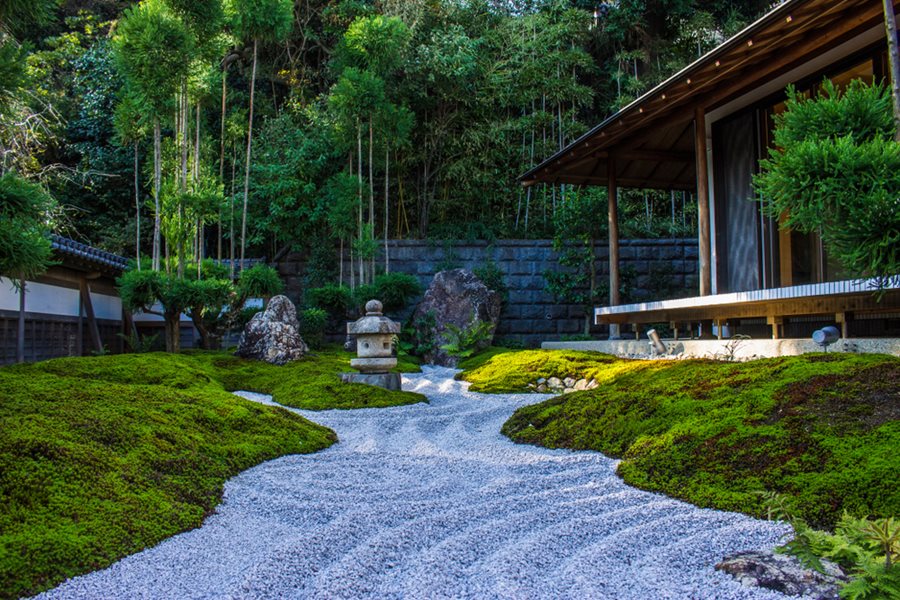
Japanese garden philosophy holds that nature is inherently asymmetrical, and rocks placed in even numbers feel static and man-made. Groups of three, five, or seven stones create dynamic visual tension, a sense that the arrangement is natural rather than designed, even when it has been very deliberately planned.
Choose rocks with interesting surface texture and natural weathering. Flat-topped stones suggest islands or plateaus. Tall vertical stones represent mountains or standing figures. Wide horizontal stones anchor the composition at ground level. The traditional grouping places the tallest stone slightly off-center, flanked by medium and small stones that support without competing.
Set each rock 4 to 6 inches into the gravel or soil so it appears to emerge from the earth rather than sit on top of it. Use local stone where possible; it looks more natural and costs less. The Japanese tradition of naming stone formations reflects how central rocks are to the culture’s relationship with landscape. Budget: low to mid, $50 to $300 depending on stone size and transport.
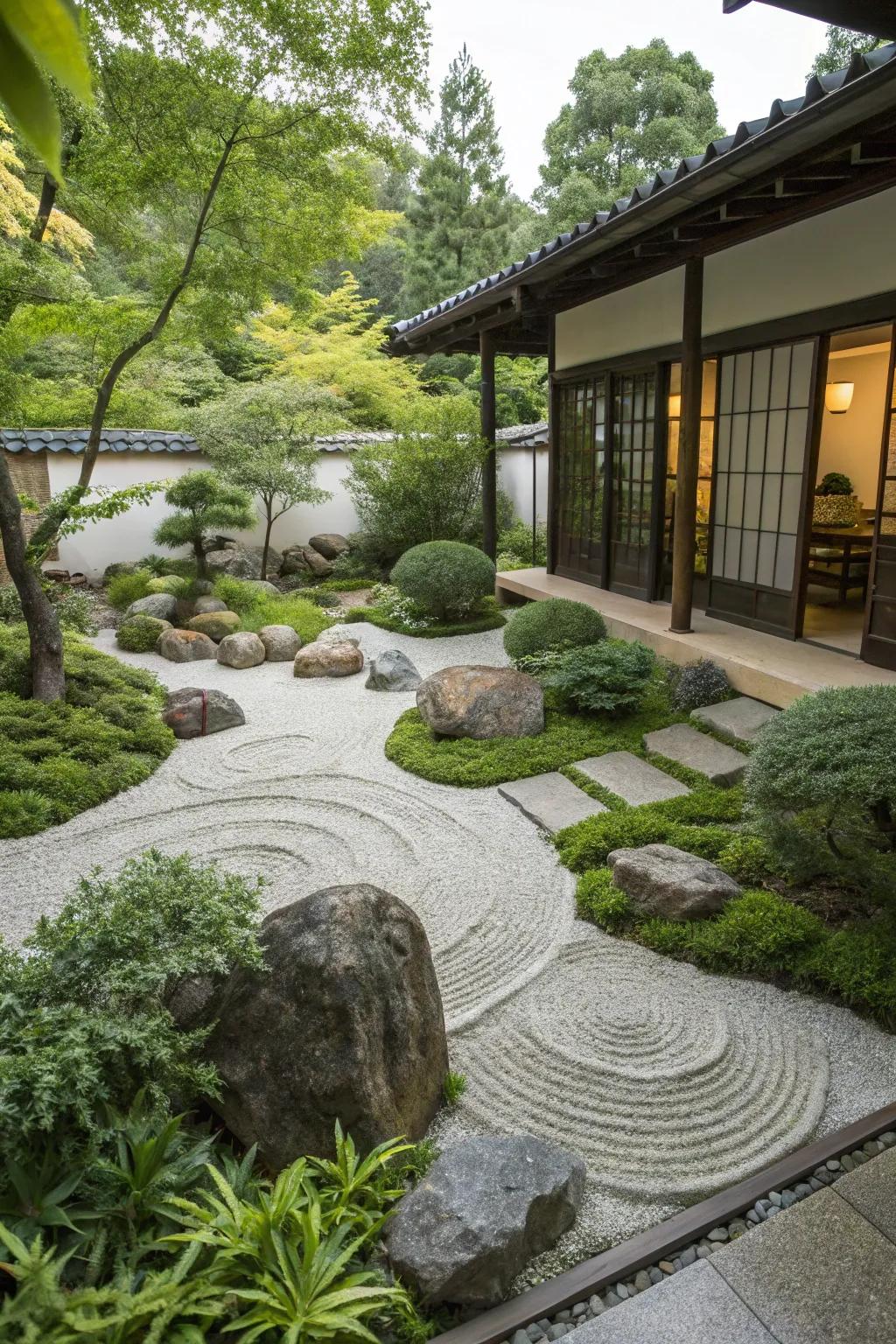
10. Torii Gate Garden Entrance
A torii gate marks a threshold: the transition from the ordinary world into a sacred or contemplative space. In traditional Japanese design, torii gates are painted vermilion red, a color associated with warding off negative energy. In residential gardens, they mark the entrance to the zen garden area itself, creating a psychological moment of transition that changes how you experience the space you’re about to enter.
Modern garden torii gates range from simple timber A-frames with a crossbeam to more elaborate two-post forms with a curved lintel. Cedar and teak hold up well outdoors without painting; painted red powder-coated steel versions are available for a more traditional look. Height should be proportional to the path width: a 4-foot-wide path works well with a gate 7 to 8 feet tall.
Flank the gate with low clipped azaleas, ornamental grasses, or a pair of stone lanterns to frame the entrance. Budget: mid, $300 to $900 for a quality timber or steel gate.
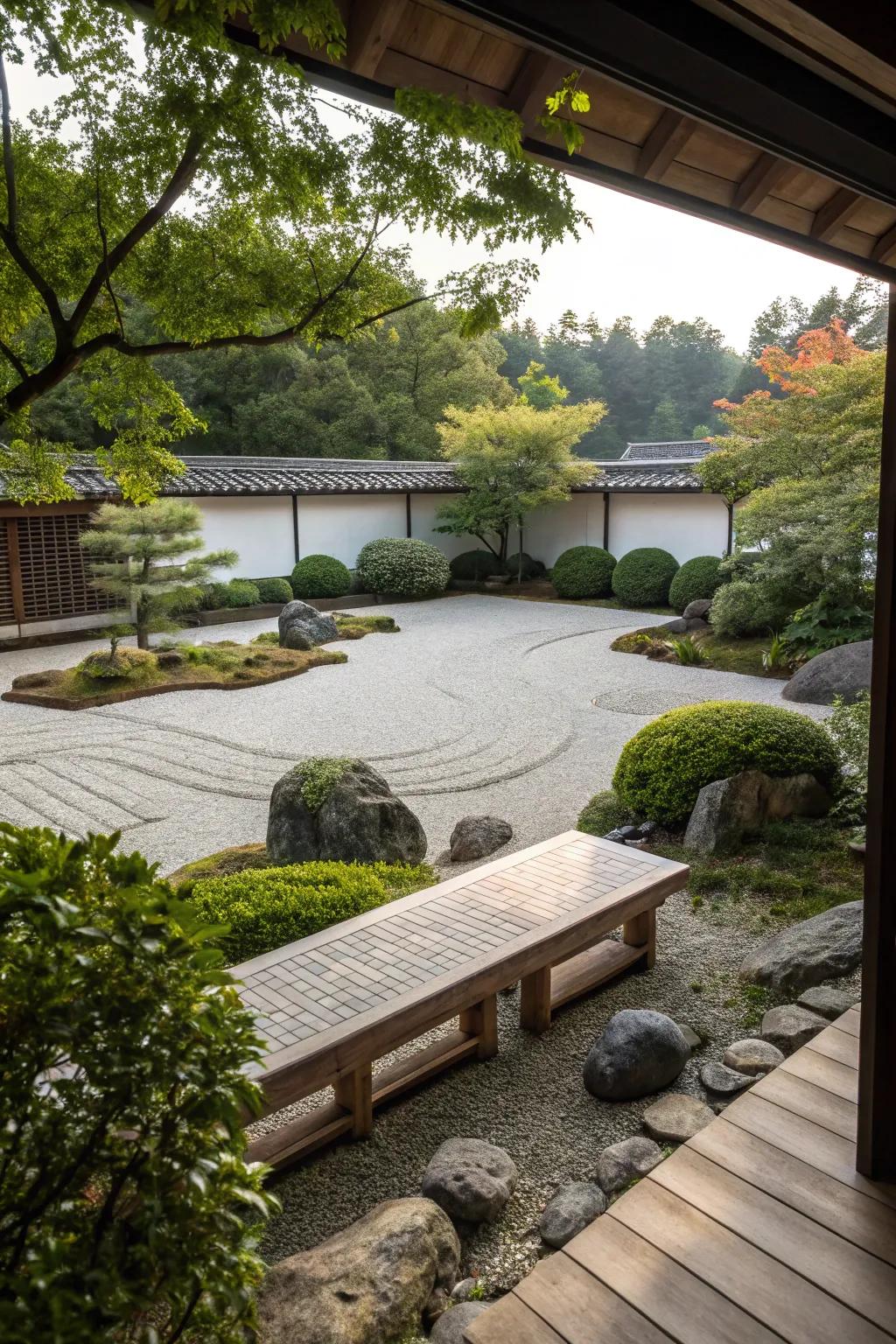
11. Dry Stone Waterfall Karetaki
The karetaki, or dry stone waterfall, is a classic karesansui technique that represents flowing water entirely through the arrangement of stone. Tall vertical stones are placed lengthwise to suggest the cascade itself, flanked by progressively lower stones that represent the banks and basin below. Raked gravel at the base completes the illusion of water flowing outward.
A well-constructed karetaki needs no water at all and requires zero maintenance beyond occasional gravel raking. It works particularly well in a corner or against a fence where a real waterfall would need significant infrastructure. The visual effect is surprisingly convincing when the stones are chosen for shape rather than just size: bluestone columns, basalt pillars, and rough-cut granite all work well depending on the overall garden palette.
The dry waterfall reads best from a single viewpoint, so place it directly opposite the garden’s primary seating position. Budget: mid, $300 to $800 for stones and gravel.
12. Bamboo Grove Corner
A dense planting of clumping bamboo in a corner creates one of the most dramatic vertical elements possible in a garden without structural construction. The tall, hollow canes sway in the wind and create a quiet rustling sound that complements the visual stillness of raked gravel below. Bamboo also screens neighboring views and creates the sense of depth and enclosure that traditional Japanese garden designers worked hard to achieve in relatively small spaces.
Use clumping rather than running bamboo to keep the planting contained. Fargesia robusta and Fargesia murielae are both excellent choices for smaller spaces in temperate climates, reaching 8 to 12 feet while staying well-behaved. In warmer climates, Bambusa multiplex ‘Alphonse Karr’ adds golden-green culm coloring that catches the light beautifully.
Underplant the bamboo with moss or black mondo grass to maintain the Japanese aesthetic at ground level. The names for wind and nature in Japanese, like those listed at Japanese names meaning wind, reflect how deeply the culture associates bamboo with the sound of air. Budget: mid, $150 to $400 for an established clumping bamboo planting.
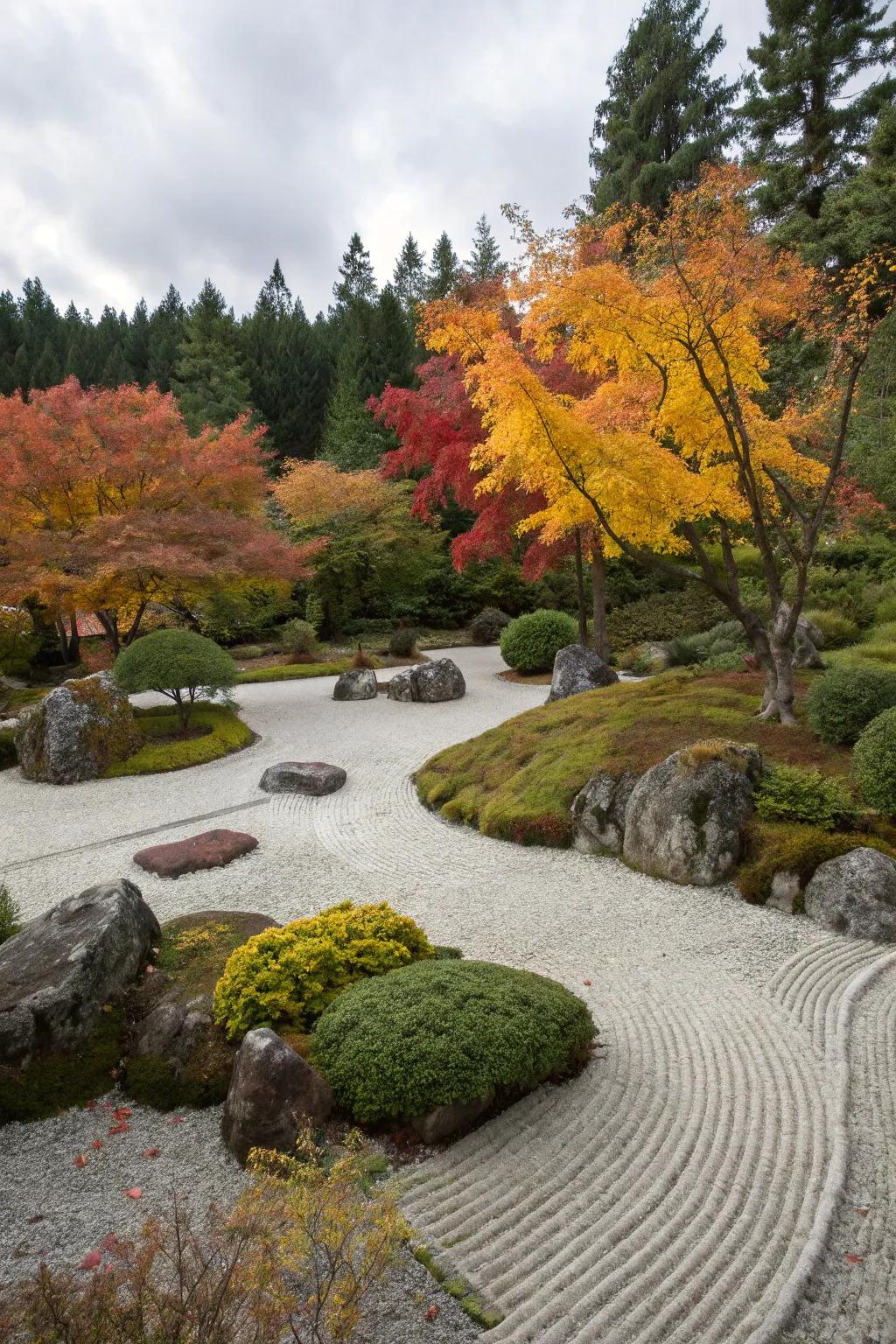
13. Cedar Wood Viewing Bench
Traditional zen gardens were designed to be viewed from a single fixed vantage point, usually the porch or engawa of the adjacent building. A cedar viewing bench replicates that relationship in a standalone garden, giving you a defined place to sit, look, and let the mind settle. The placement of the bench determines the entire compositional logic of the garden in front of it.
Cedar is the preferred material for outdoor furniture in Japanese-inspired gardens: it weathers to a beautiful silver-grey, resists rot without chemical treatment, and has a warm grain that suits natural stone and gravel palettes. A simple bench at 18 inches height, 48 to 60 inches wide, with a slightly reclined backrest, sits comfortably at human scale without dominating the garden view.
Position the bench so the primary stone grouping, tree, or water feature sits directly in the visual center from the seated position. Frame the view with low bamboo planting on either side. Budget: low to mid, $150 to $450 for a quality cedar bench.
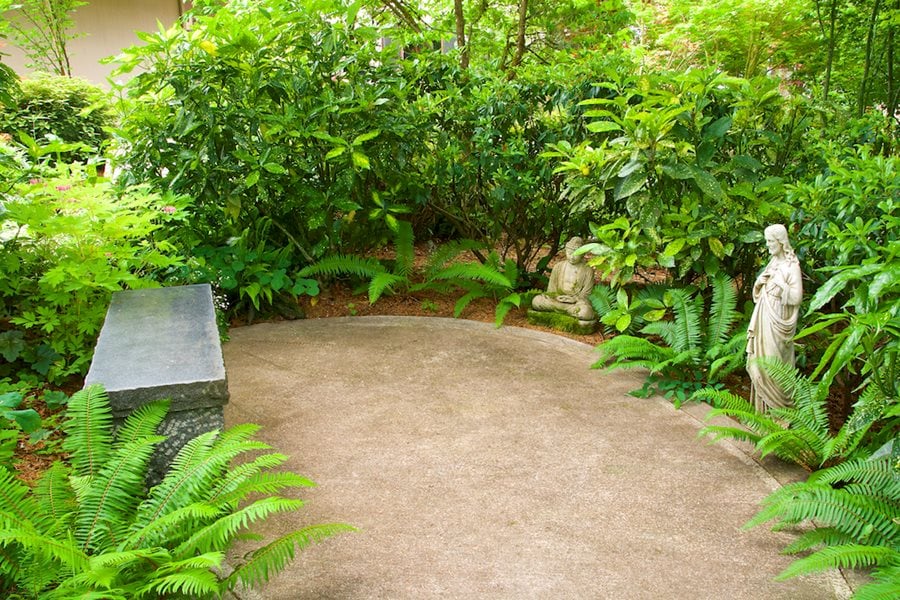
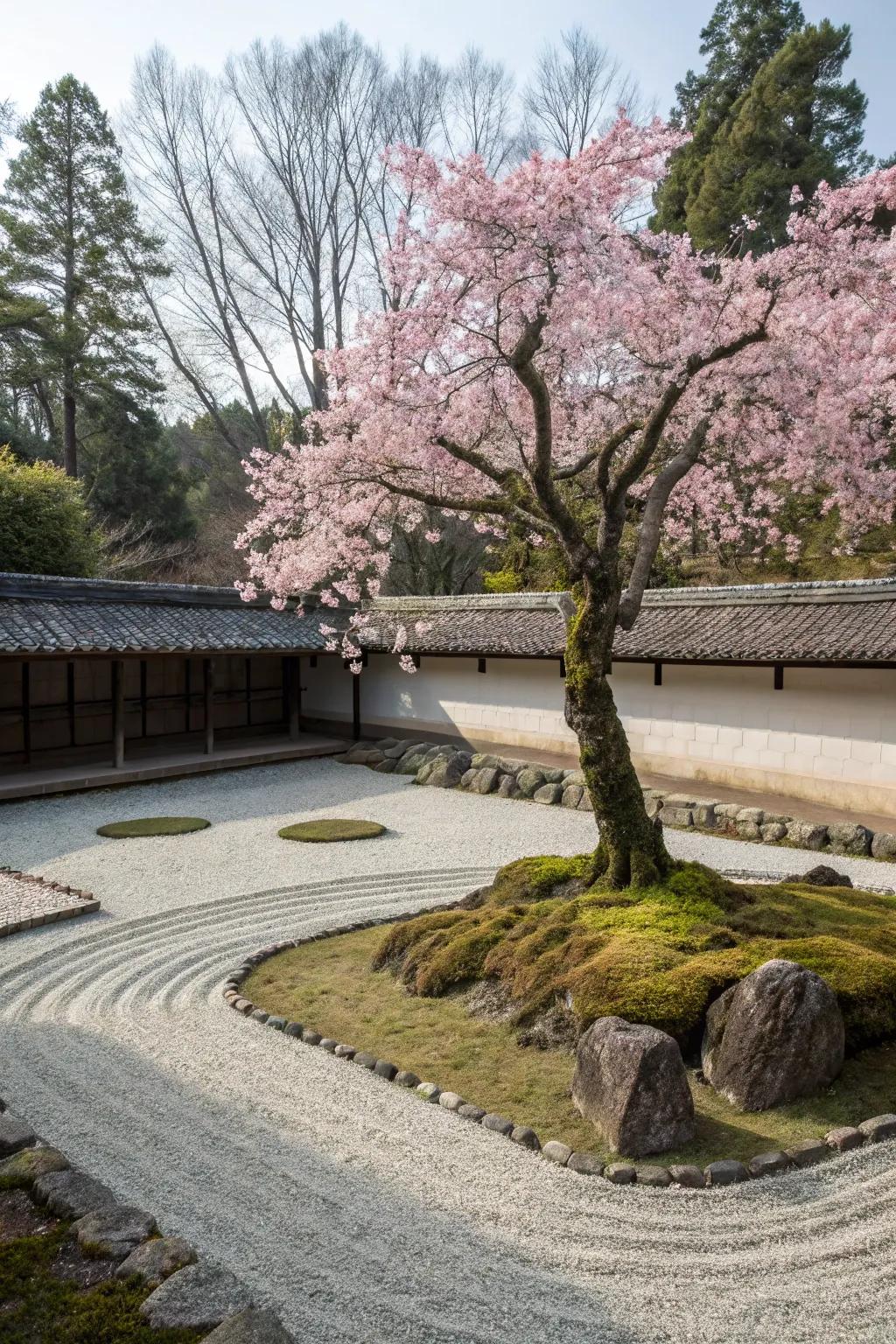
14. Cherry Blossom Sakura Tree
Few things communicate the Japanese garden aesthetic as powerfully as a cherry blossom tree in full spring bloom. The brief, spectacular flowering of sakura, lasting only one to two weeks, embodies the core Japanese concept of mono no aware: the poignant beauty of impermanent things. In a zen garden, a cherry tree provides the single most dramatic seasonal moment of the year.
For residential gardens, Prunus serrulata ‘Kwanzan’ delivers the classic double-pink blossom in a manageable 25-foot form. Prunus x yedoensis (Yoshino cherry) produces single white flowers and is the variety planted throughout Washington DC’s famous National Mall. Smaller spaces do well with Prunus ‘Amanogawa’, a fastigiate (columnar) form that reaches 20 feet tall but only 4 feet wide.
Plant the cherry tree as the garden’s primary vertical element, slightly off-center in the composition. Underplant with white-flowering mondo grass for continuity between tree and ground. Budget: mid, $80 to $250 for a young tree.
15. Layered River Rock for Natural Texture
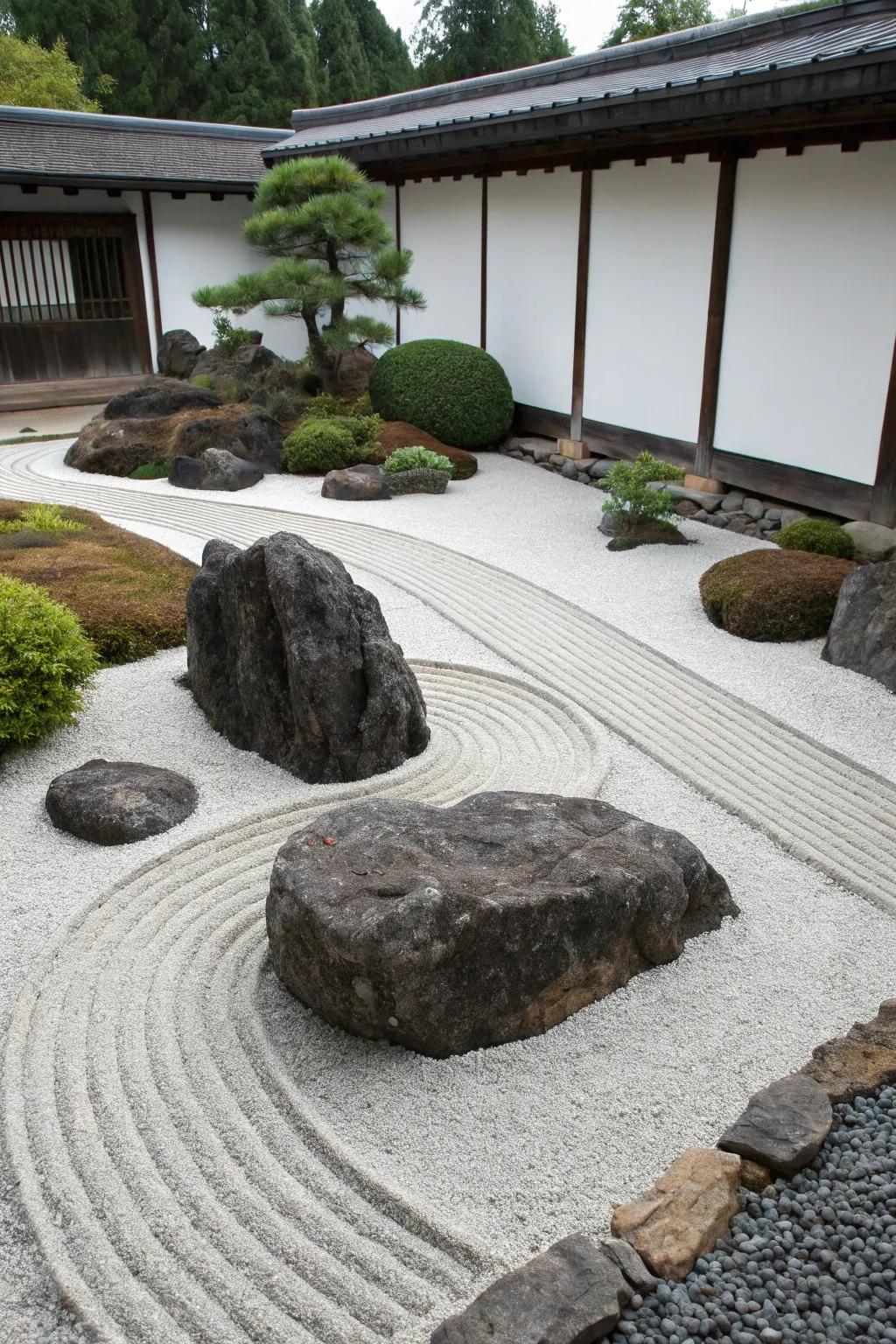
River rocks, smoothed by water over millennia, bring an organic textural variety to zen gardens that uniform gravel alone can’t provide. Used as a transitional layer between raked gravel areas and planted borders, or mounded around the base of boulders to simulate a streambed, river rocks add depth and visual complexity while remaining entirely in keeping with the natural materials palette.
Dark grey or charcoal river cobbles contrast beautifully against pale granite gravel. Brown river pebbles warm up cooler stone palettes. Mixing sizes, from fist-sized cobbles to palm-sized smooth pebbles, creates more natural-looking arrangements than uniform sizes alone. The connection to water symbolism in Japanese garden philosophy makes river rock one of the most semantically rich materials you can use.
River rock is particularly effective as a dry streambed running across the garden, starting narrow at a simulated source point and widening as it moves downslope, even if the actual grade change is only a few inches. Budget: low, $60 to $180 per cubic yard depending on stone type.
16. Miniature Desktop Zen Sand Garden
Not every zen garden needs a backyard. The miniature sand garden, a shallow tray of fine sand with small stones and a pocket rake, brings the meditative practice of raking into any indoor or tabletop space. Office desks, meditation rooms, and apartment balconies all work as locations for a small-scale version of the karesansui tradition.
The practice translates surprisingly well at miniature scale. Raking patterns around small stones, smoothing the surface, and starting again carries the same mental reset effect as the full garden version. The visual simplicity of a well-raked sand tray on a desk also contributes to the ambient calm of the surrounding space.
Quality miniature zen gardens use natural sand in white or grey, smooth river pebbles, and a handcrafted wooden or bamboo rake. Avoid cheap plastic versions with overly artificial-looking stones. Budget: very low, $20 to $80 for a quality desktop set.
17. Ferns to Soften Stone Edges
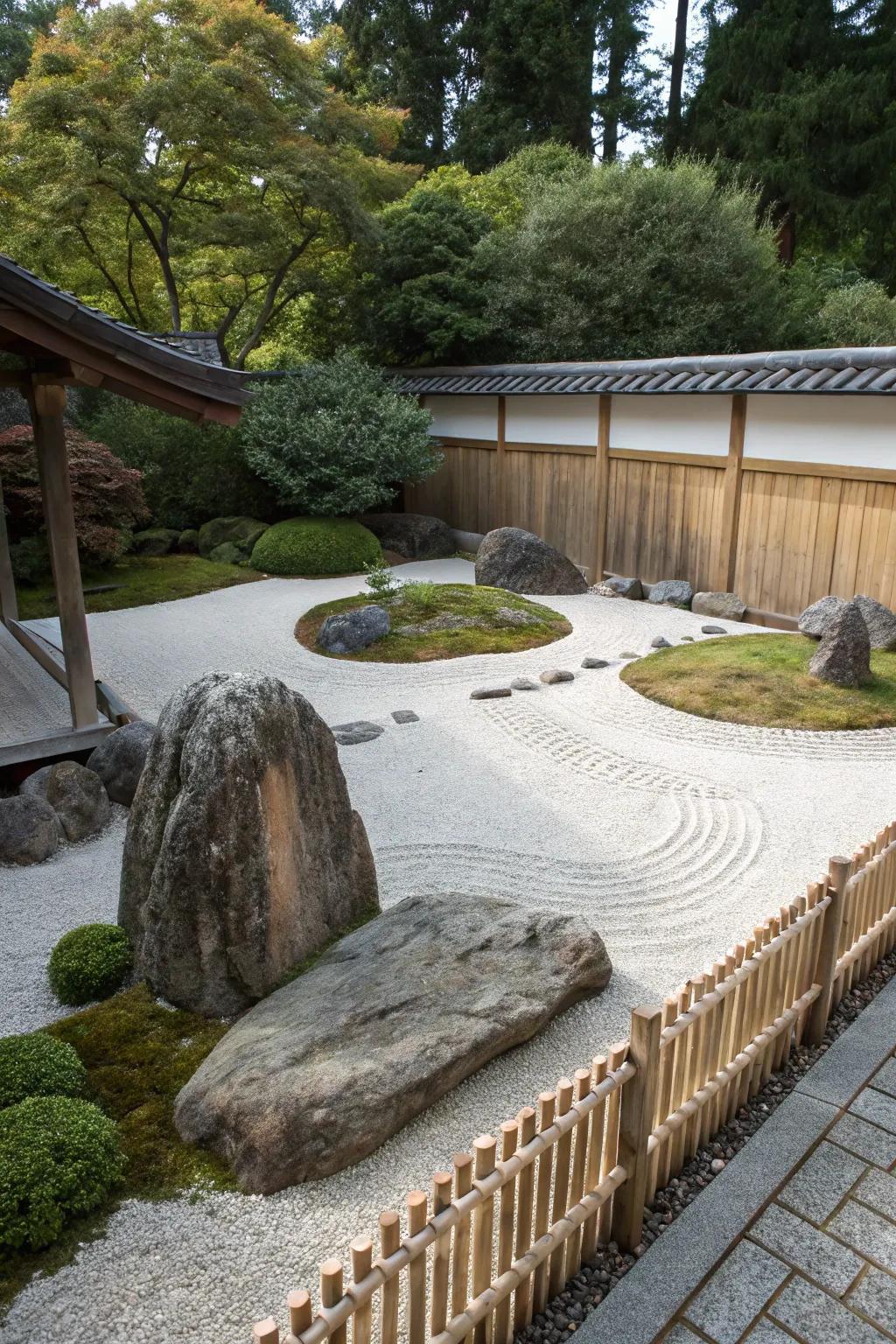
The strict geometry of raked gravel and angular stone can feel austere without some plant material to introduce softness and organic irregularity. Ferns do this better than almost any other plant in a shaded zen garden: their arching fronds fill in around stone edges, their texture contrasts with the hard surfaces, and their deep greens anchor the composition through spring, summer, and autumn.
Hart’s-tongue ferns (Asplenium scolopendrium) and wood ferns (Dryopteris) are slow-growing, evergreen, and well-suited to the damp, shaded conditions typical of a zen garden corner. Japanese painted fern (Athyrium niponicum) adds silver-green variegation that catches light elegantly in darker areas.
Plant ferns in clusters of three or five at the base of boulders, along bamboo screen edges, or at the transition between gravel and a planted border. Mixing hart’s-tongue ferns with moss ground cover creates a particularly cohesive and lush textural layer at ground level. Budget: very low, $15 to $30 per plant.
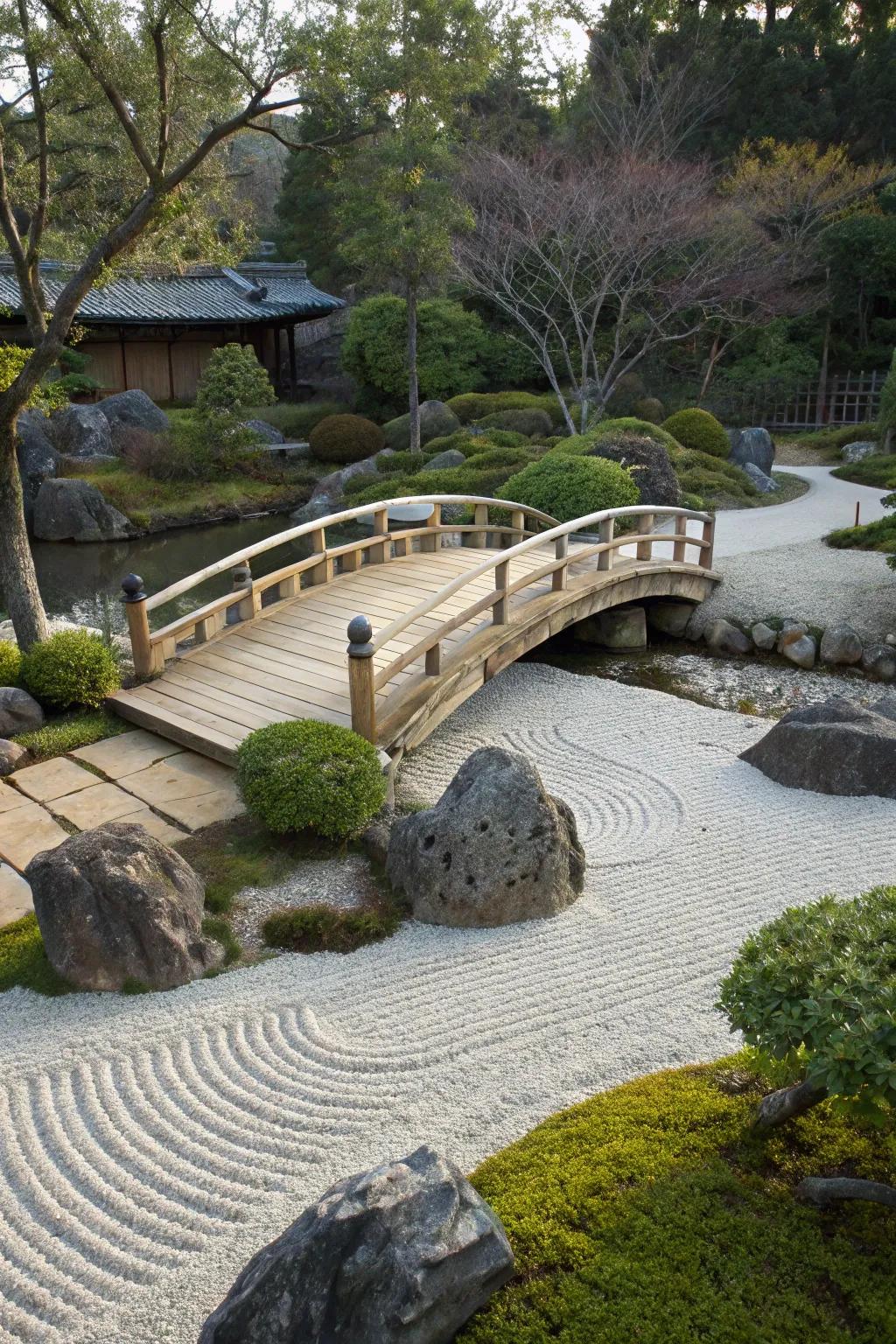
18. Wooden Arched Bridge Over Gravel
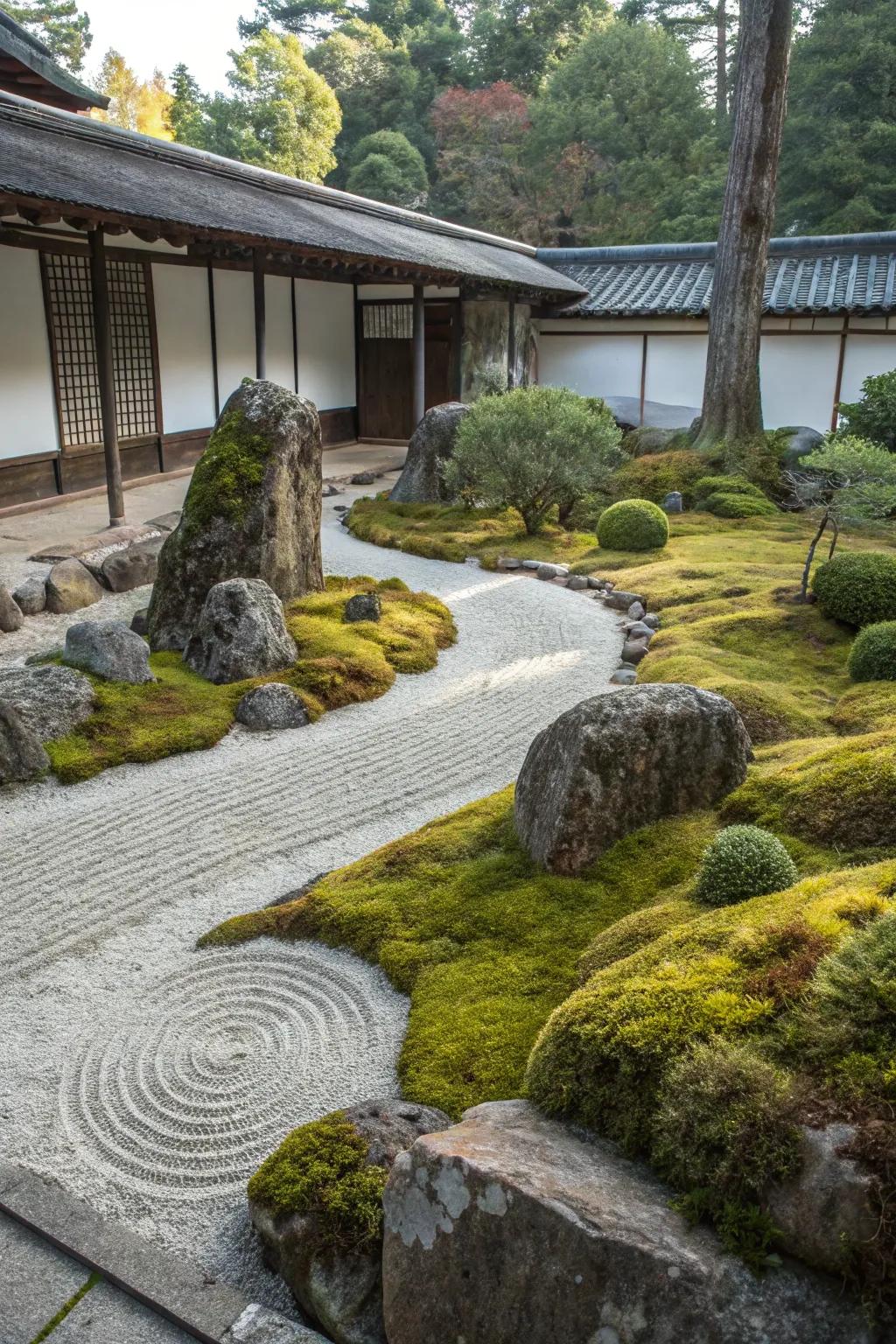
A small arched wooden bridge crossing a dry stream or gravel field is one of the most charming and distinctive structural elements in Japanese garden design. The bridge doesn’t need water beneath it to make sense: in karesansui tradition, the gravel represents water, and the bridge represents the act of crossing from one state of mind to another.
Cedar and teak are the best timber choices for an outdoor bridge because they resist rot without chemical treatment and age gracefully to a silver-grey that suits stone and gravel palettes. A bridge 4 to 6 feet long, arching 6 to 10 inches at the center, works well over a dry stream 3 feet wide. Add simple handrail posts in bamboo or cedar for scale and safety.
The bridge works best when it connects two distinct areas of the garden: a moss area to a gravel area, or a planted border to the primary viewing space. Budget: mid to high, $350 to $900 for a quality cedar bridge.
19. Bonsai Container Display
Bonsai, the art of cultivating miniature trees in shallow containers, is one of the most demanding and rewarding disciplines in Japanese garden culture. A single well-trained bonsai placed on a viewing stone or cedar stand becomes one of the most intense focal points a garden can have: a full landscape in miniature, shaped over years or decades.
For outdoor display in a zen garden, juniper bonsai (Juniperus) and Japanese maple bonsai tolerate the climate range of most temperate regions. Both develop the fine branch ramification and aged-bark character that makes a bonsai compelling as a garden object. Display on a flat stone slab or low cedar table at eye level from the garden bench.
Bonsai require consistent watering (daily in summer), seasonal repotting, and careful pruning. The time investment is part of the practice, and many people find bonsai care as meditative as raking gravel. Budget: varies widely, $50 to $500 for a quality beginner tree.
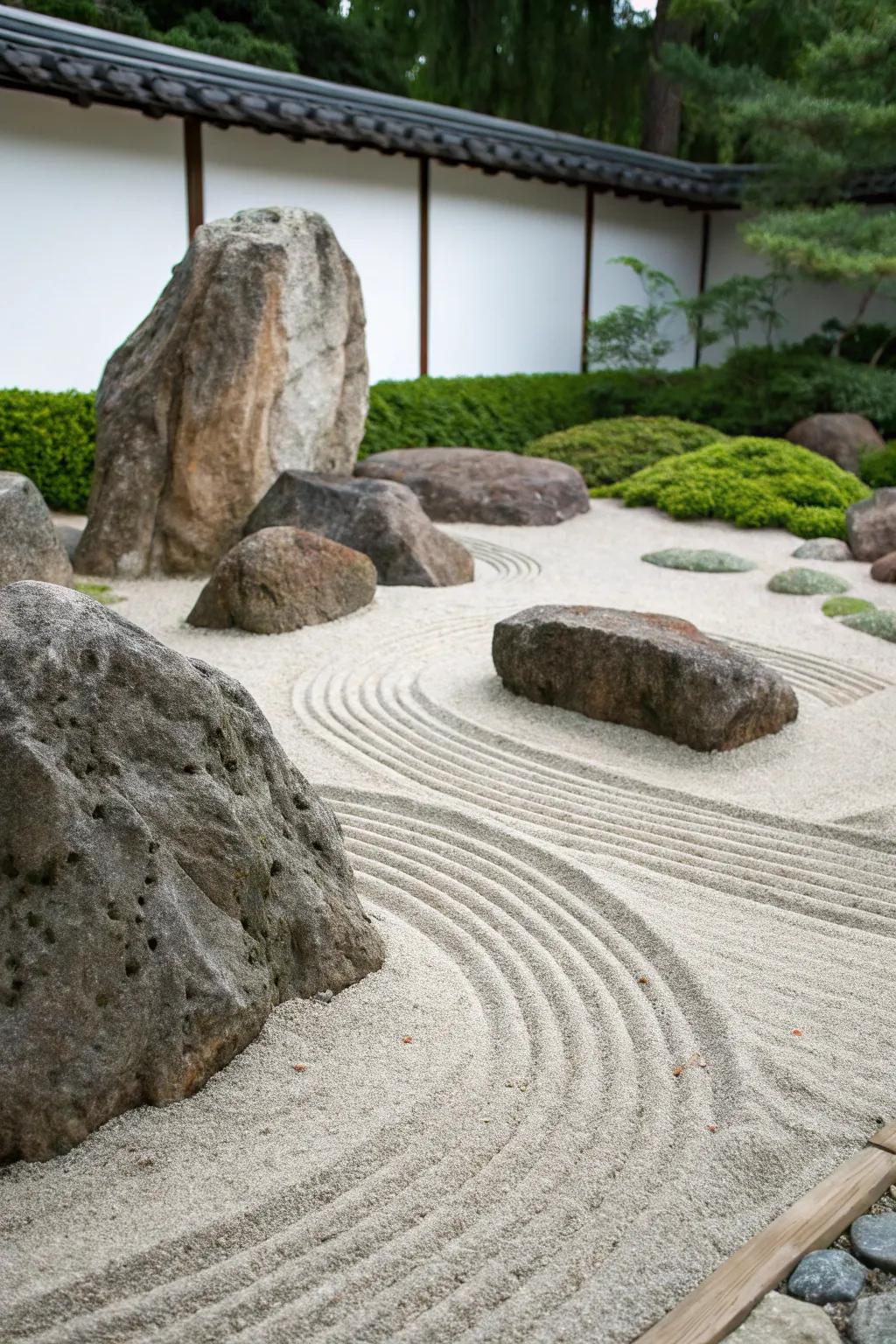
20. Enclosed Garden with Low Stone Wall
Traditional karesansui gardens at Kyoto temples are always enclosed, set apart from the surrounding landscape by a wall that defines the garden as a separate world. A low dry-stacked stone wall between 18 and 36 inches high performs this function in a residential setting without dominating the space or blocking views from outside.
Dry-stacked fieldstone or flat limestone are the most natural-looking options. The irregular texture and slight imperfection of hand-laid stone suits the wabi-sabi aesthetic far better than precisely cut block walls. Tuck low groundcovers like creeping thyme or baby tears into the crevices to soften the structure over time.
A wall doesn’t need to enclose all four sides to create a sense of containment: a single low wall along one edge, combined with bamboo screening on another and a planted hedge on the third, achieves the garden room effect without full enclosure. Budget: mid to high, $400 to $1,200 depending on length and stone type.
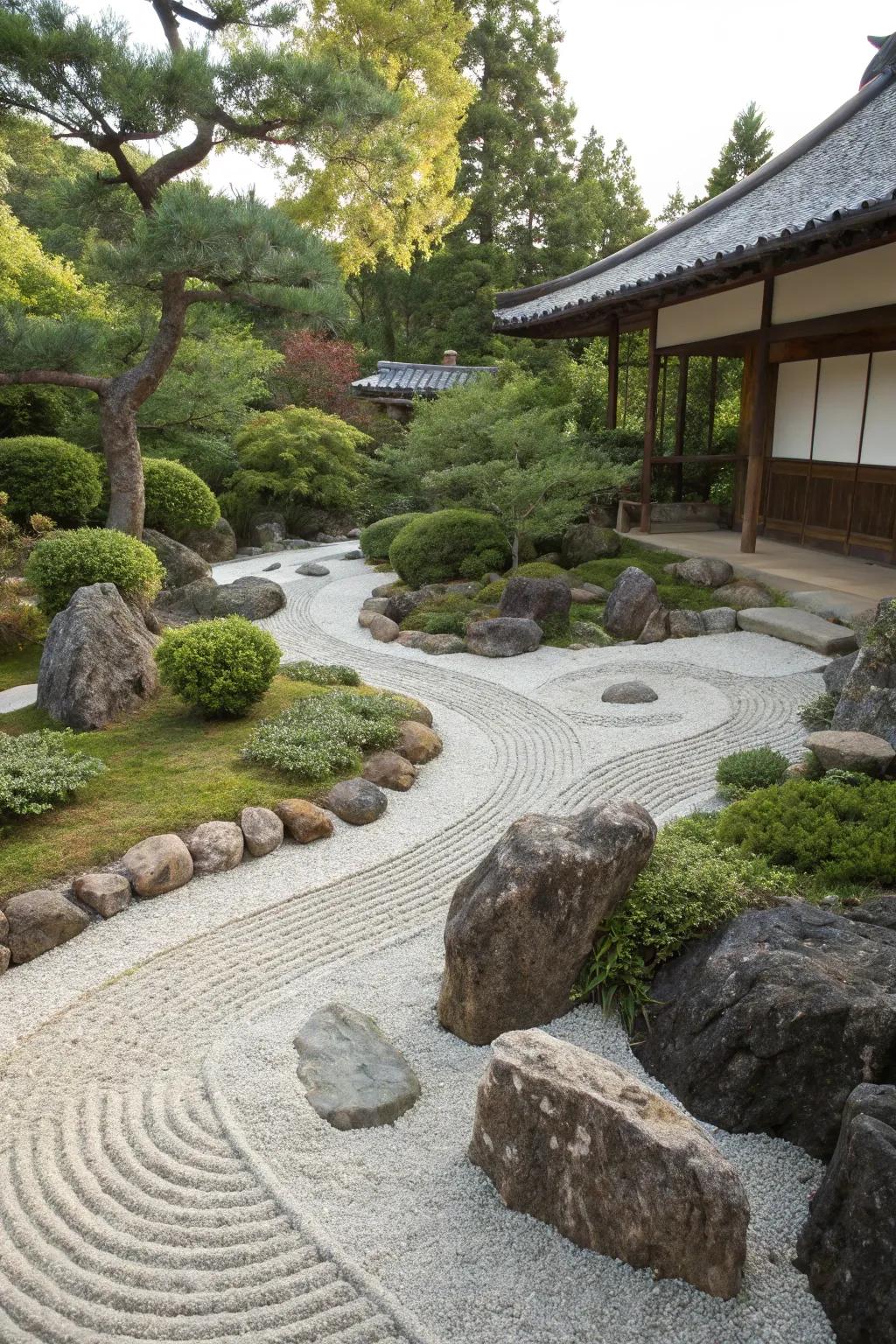
21. Solar Lantern Night Lighting
A zen garden that only works in daylight misses half its potential. Stone lanterns and solar pathway lights transform the same gravel and rock composition at night into something quieter and more atmospheric, with pools of warm light catching the texture of raked patterns and throwing shadows across stone faces that are invisible in flat daytime light.
Solar-powered stone lantern replicas have improved considerably in recent years. Quality versions use warm-white LED elements (2700K to 3000K color temperature) that mimic candlelight convincingly. Position two or three lanterns at different heights: one at the base of the primary stone grouping, one along the pathway, and one near the garden entrance or bench.
Avoid strings of fairy lights or colored LEDs, which break the minimalist aesthetic immediately. The goal is subtle illumination that reveals rather than performs. Budget: very low, $25 to $80 per solar lantern unit.
22. Clipped Evergreen Niwaki Shrubs
Niwaki, the Japanese art of shaping trees and shrubs into deliberate architectural forms, produces the distinctive cloud-pruned or tiered silhouettes seen in classical Japanese garden photography. A pair of clipped boxwood, Japanese holly, or azalea shrubs flanking a stone lantern or pathway entrance makes an immediate and powerful design statement.
Japanese holly (Ilex crenata), boxwood (Buxus), and mugo pine are all suitable for niwaki cloud pruning because they respond well to hard cutting and maintain dense interior growth. The basic cloud form involves removing growth between defined pom-pom masses on horizontal branches, creating the floating cloud effect. It takes several years to develop but can be maintained with twice-annual pruning.
Even a simple pair of dome-pruned boxwood in matching glazed containers flanking the garden entrance creates a sense of formal intention that elevates the whole composition. Budget: low for plants, skill required for shaping, professional shaping $200 to $500 annually.
23. Gravel Color and Pattern Variation
Most homeowners default to white or grey gravel for a karesansui garden, but playing with color contrast and pattern variation creates a more nuanced and sophisticated composition. Dark charcoal or black basalt gravel used as a contrasting border or inlay alongside pale white quartz creates graphic lines and shapes within the gravel field that are visible even without raking.
Common techniques include a single ring of dark pebbles around each boulder grouping to define the water-ripple area before the wider raked field begins, alternating bands of light and dark gravel for a striped river effect, and geometric inlaid shapes in contrasting gravel colors. The design principle is restraint: one or two intentional contrasts rather than a pattern that competes with the stone placement for visual attention.
The symbolism of light and dark in Japanese aesthetics runs deep, making thoughtful gravel color contrast a semantically resonant design choice as well as a visual one. Budget: low to mid, $100 to $300 for an upgraded gravel palette.
24. Courtyard Zen Garden for Small Spaces
An enclosed courtyard, even one as small as 8 by 10 feet, can function as a complete karesansui composition. The confined dimensions actually help: they force prioritization, which produces cleaner, more powerful design. Some of the most celebrated zen gardens in Japan, including the famous garden at Ryoanji Temple in Kyoto, occupy relatively modest rectangular footprints.
A courtyard zen garden typically uses a single layer of fine white gravel as the primary surface, two or three stone groupings sized in proportion to the space, and a single specimen plant, usually a bonsai on a stand or a compact Japanese maple in the corner. Walls are treated as part of the design, perhaps with a bamboo panel mounted as a backdrop or a single stone lantern in the corner providing height.
The viewing point is often through a glass door or sliding patio door, which means the garden works as an art installation visible from indoors as well as a space to inhabit when weather permits. Budget: mid, $400 to $1,000 for a complete small courtyard installation.
25. Flagstone and Pebble Contrast Paving
Alternating areas of large flat flagstone with bands or borders of small river pebbles creates a complex, richly textured paving surface that feels unmistakably Japanese without a single plant in sight. The contrast between the smooth, broad face of the flagstone and the rounded, irregular texture of the pebble infill is inherently pleasing and ages beautifully over time as moss fills the pebble joints.
Local bluestone, sandstone, or irregular slate work well for the flagstone elements. Use pea gravel or small river cobbles in a complementary tone for the pebble infill areas. Set flagstones on a compacted gravel base with a sand leveling layer; pack pebble infill tightly between them.
This approach works particularly well for a garden path leading from the house to the zen garden proper, where the transition in underfoot texture signals the change in spatial character before the garden even comes into full view. Budget: mid, $350 to $900 for a 10 by 12 foot area.
26. Dedicated Meditation Seating Area
The purpose of a zen garden, at its core, is to support a practice: meditation, contemplation, or simply unhurried presence. A dedicated seating area designed specifically for that purpose, rather than general outdoor entertaining, changes how the space is used. A low meditation cushion on a cedar platform, a simple stone seat, or a traditional wood bench set directly on gravel all communicate the same intention.
The key design move is positioning the seating so the primary garden composition is fully visible from it. No tree trunks cutting across the view. No fence posts in the sightline. The garden should look like a composed painting from the seated position. Low ambient planting on either side of the seating frames the view without blocking it.
A small cedar side table at bench height with room for a tea cup completes the setup. Some homeowners add a simple bamboo wind chime directly above the seating position for the gentle sound element. Budget: low to mid, $100 to $400 for a quality seating setup.
27. Seasonal Accent Planting for Year-Round Interest
A purely dry karesansui garden has beautiful year-round constancy, but adding a small selection of carefully chosen plants gives the space seasonal rhythm: something to anticipate, something to watch change, something to mark the passage of time. The principle is restraint: one or two accent plantings rather than a mixed border.
Spring: a single clump of white narcissus or Japanese iris emerging at the base of a boulder. Summer: a clipped azalea in bloom, or black-stemmed bamboo against the fence catching midday light. Autumn: the Japanese maple delivering its finale in red or orange. Winter: the skeleton of the garden itself, stone and raked gravel showing clearly with no foliage to distract. Each season the garden is complete but different.
The Japanese names meaning flower reflect how deeply seasonal flowering is woven into Japanese cultural consciousness. Even a single plant chosen for one outstanding seasonal moment earns its place in a zen garden composition. Budget: very low, $20 to $80 per seasonal accent plant.
Design Tips for Japanese Zen Garden Ideas
The single most common design mistake in Western interpretations of Japanese zen gardens is overcomplication. Traditional karesansui gardens contain very few elements, but every element has been chosen and positioned with great precision. Start with your largest stone, place it asymmetrically, and let the rest of the composition build from that anchor. Add one thing at a time and live with each addition before adding the next.
Scale matters more than most homeowners realize. A single large boulder reads as powerful and deliberate. Three small boulders in the same space read as decoration. If your budget allows only one significant stone, buy one impressive piece rather than several smaller ones. The same principle applies to plants: one well-placed Japanese maple beats five mediocre shrubs.
Color restraint holds the palette together. Japanese zen gardens use white or grey gravel, dark stone, deep greens (moss, clipped boxwood, Japanese holly), and restrained seasonal color (cherry blossom, maple, iris). Avoid colorful annuals, multicolored gravel, or bright container plants. Every color element should feel inevitable rather than decorative.
Maintenance frequency determines how much garden you can realistically sustain. A gravel-only karesansui with three stone groupings requires perhaps 20 minutes of raking per week and minimal seasonal work. Adding a koi pond, bonsai, and niwaki shrubs multiplies that significantly. Design for the maintenance level you will actually commit to, not the one you hope to commit to. The zen principle of clarity applies to garden management as much as garden design.
Common Mistakes to Avoid With Japanese Zen Garden Ideas
Overcrowding the gravel field. The power of a karesansui garden comes from open space. Every additional stone, plant, or ornament placed in the gravel field reduces the visual breathing room that makes the composition work. If you’re not sure whether to add something, don’t add it. You can always add later. Removing something already embedded in gravel is much more work.
Using the wrong gravel size. Coarse gravel or decorative chipped stone doesn’t rake cleanly and doesn’t hold patterns the way fine gravel does. Pea gravel under 3/8 inch diameter, finely crushed white granite, and decomposed quartz all work. Lava rock, dyed stone, and large decorative pebbles don’t belong in a karesansui composition.
Symmetrical placement. Symmetry is one of the most common Western design instincts and one of the things that immediately reads as non-Japanese in a garden composition. Two identical lanterns flanking a centered bench, a stone path bisecting the gravel field in a straight line, plants placed in matching pairs all undercut the naturalistic asymmetry that zen garden aesthetics depend on.
Neglecting the enclosure. A zen garden without some form of boundary, whether bamboo screening, a low wall, dense hedging, or a structural fence, lacks the sense of separation from the outside world that makes the space feel transformative. Even a partial enclosure, screening two of the four sides, makes a significant difference to how the garden reads and how it feels to spend time in.
Ignoring the viewing angle. Traditional zen gardens are designed for a specific viewpoint. If you add a stone grouping in a corner that can’t be seen from the garden bench or the house window, you’ve lost the point. Design from the viewer’s position outward, not from the middle of the space outward.
Seasonal planting without exit strategy. If you add flowering plants to a zen garden, choose varieties that look composed when not in bloom. An azalea or Japanese iris in off-season is part of the garden’s structure. A dahlia or zinnia in off-season is a mess of dry stems in a clean composition.
Check These Related Ideas
- Zen Names for Boys, Girls, and Unisex
- Japanese Names That Mean Water for Boys, Girls and More
- Japanese Names That Mean Wind
- Japanese Names That Mean Flower for Boys and Girls
- Japanese Names That Mean Light for Boys, Girls and More
A Japanese zen garden doesn’t announce itself. The ones that work best are the ones you walk into and feel differently almost before you notice why. Stone, gravel, moss, water, and a little intentional silence. That’s the whole recipe.
The best place to start is smaller than you think. Pick one corner, clear it, lay down a bed of fine gravel, choose one impressive stone, and rake it. Spend time sitting with that before adding anything else. The discipline of restraint is the practice, and the practice is the garden. For more ideas across the full spectrum of Japanese design, explore zeninhome.com.
Frequently Asked Questions
What is a Japanese zen garden called?
A traditional Japanese zen garden is called a karesansui, meaning dry landscape. It uses rock, gravel, and sand arranged to represent natural elements like water and mountains, with few or no plants.
How much does it cost to build a Japanese zen garden?
A simple backyard zen garden with gravel, stones, and a lantern costs $300 to $800. A full design with koi pond, bamboo screening, and specimen trees can run $2,000 to $8,000 depending on size and materials.
What plants belong in a Japanese zen garden?
Classic zen garden plants include Japanese maple, moss, clipped azalea, bamboo, black mondo grass, Japanese iris, cherry blossom, mugo pine, and ferns. The principle is restraint: one or two well-chosen plants rather than many.
How do you maintain a zen garden gravel?
Rake the gravel once or twice a week with a wide-toothed bamboo or wooden rake to refresh the patterns. Remove fallen leaves with a fine-toothed metal rake or leaf blower on low. Pull weeds by hand or use landscape fabric beneath the gravel to prevent them.
Can I make a Japanese zen garden in a small space?
A zen garden works well in small spaces. A 6 by 8 foot courtyard or side yard is enough for a complete karesansui composition. Small-space zen gardens often look stronger than large ones because the limited area forces tighter design decisions.
What gravel is best for a Japanese zen garden?
Fine gravel under 3/8 inch diameter rakes cleanly and holds patterns best. White crushed granite, decomposed quartz, and fine pea gravel in white, grey, or cream are the most authentic and practical choices. Avoid dyed stone, lava rock, or coarse decorative gravel.
Does a Japanese zen garden need water?
No. The classic karesansui is a dry garden that represents water symbolically through raked gravel patterns and stone arrangement. Water features like tsukubai basins or koi ponds are optional additions that bring sound and movement but are not required for an authentic design.
