21 Backyard Zen Garden Ideas That Turn Any Yard Into a Calm Retreat
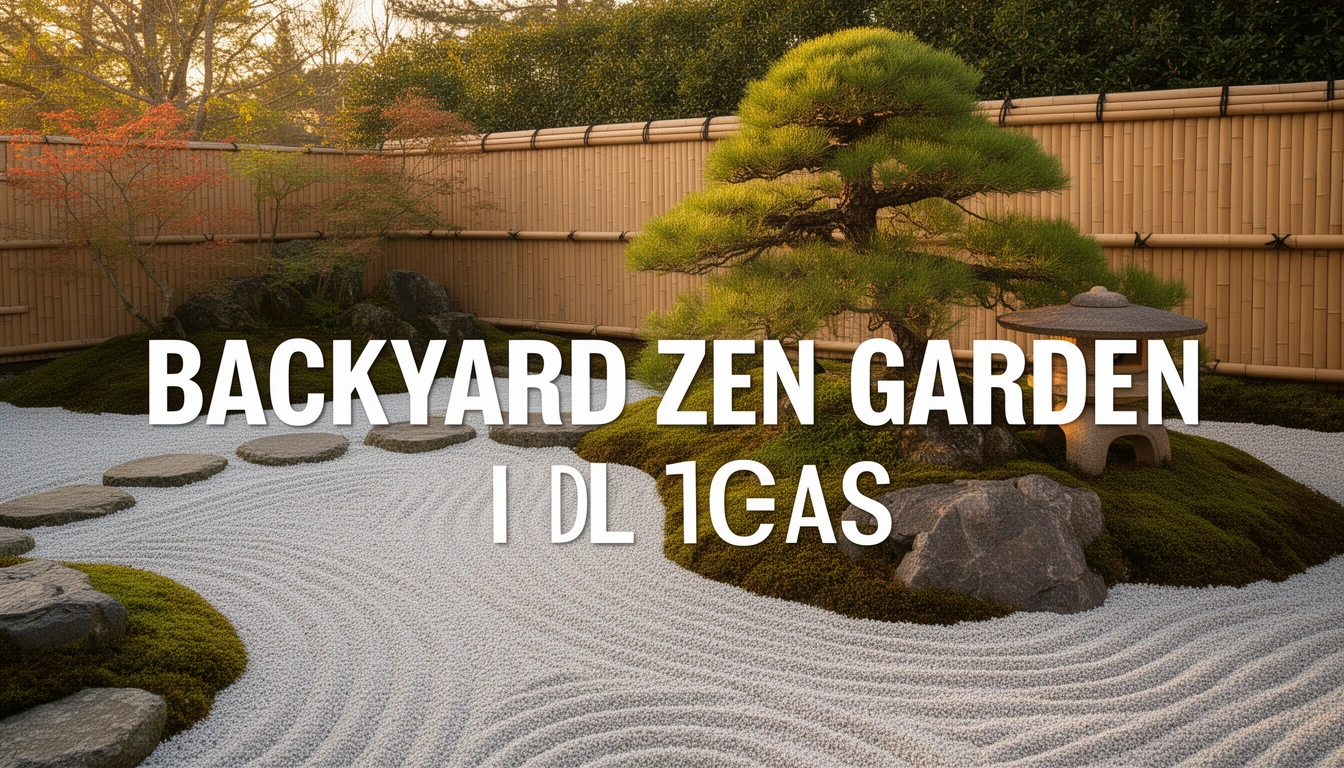
Most backyards end up as afterthoughts: a patch of lawn, maybe a plastic patio set, and a corner that gradually fills with things nobody knows where else to put. A backyard zen garden changes that completely. It gives the space purpose, a reason to step outside without a task in hand, and a place where ten minutes of sitting feels genuinely restorative.
The best part is that the budget, the style, and the scale are entirely up to you. You can rework an entire yard or claim a single forgotten corner and build something there. Zen design works with restraint, so less material means less cost and, often, more impact. Raked gravel, a handful of carefully chosen stones, a dwarf pine, and a bamboo screen are all you need to shift the whole feel of a space.
These 21 backyard zen garden ideas cover a wide range of styles, yard sizes, and budgets. Whether you’re drawn to the dry minimalism of traditional karesansui design or a more modern interpretation that blends japandi aesthetics with natural stone paths, there’s an approach here that fits your space, your time, and how you actually want to feel when you step outside.
1. Classic Raked Gravel Bed With Anchor Stones
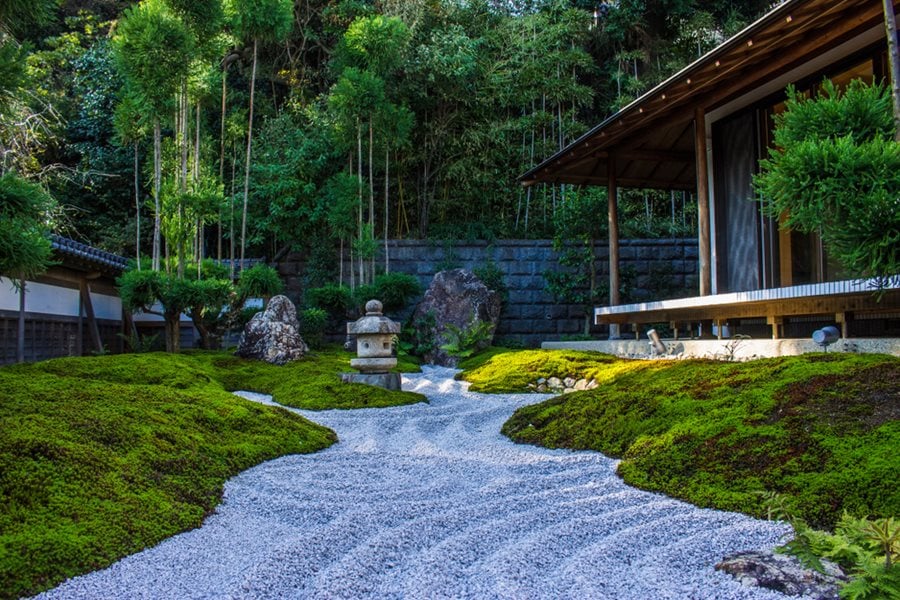
A raked gravel bed is the foundation of traditional zen garden design, and it works just as well in a suburban backyard as it does in a Japanese monastery. The idea is simple: a flat area of fine-crushed granite or pea gravel, raked into patterns that suggest flowing water, with two or three large anchor stones placed with intention.
The anchor stones do the heavy lifting visually. Group them in odd numbers: three stones of varying height create a small mountain formation; a single large boulder surrounded by flat pebbles reads as an island rising from a still sea. Crushed granite in light gray or cream tones holds rake lines cleanly and doesn’t shift in wind the way fine sand does. Lay woven landscape fabric beneath before adding 3 to 4 inches of gravel, and edging with flat stone or low corten steel keeps everything contained.
This layout works in any climate and scales from a 4×8 foot raised bed to a full half-yard transformation. Budget: $200 to $600 for materials, depending on square footage and stone size.
2. Bamboo Tsukubai Water Spout and Basin
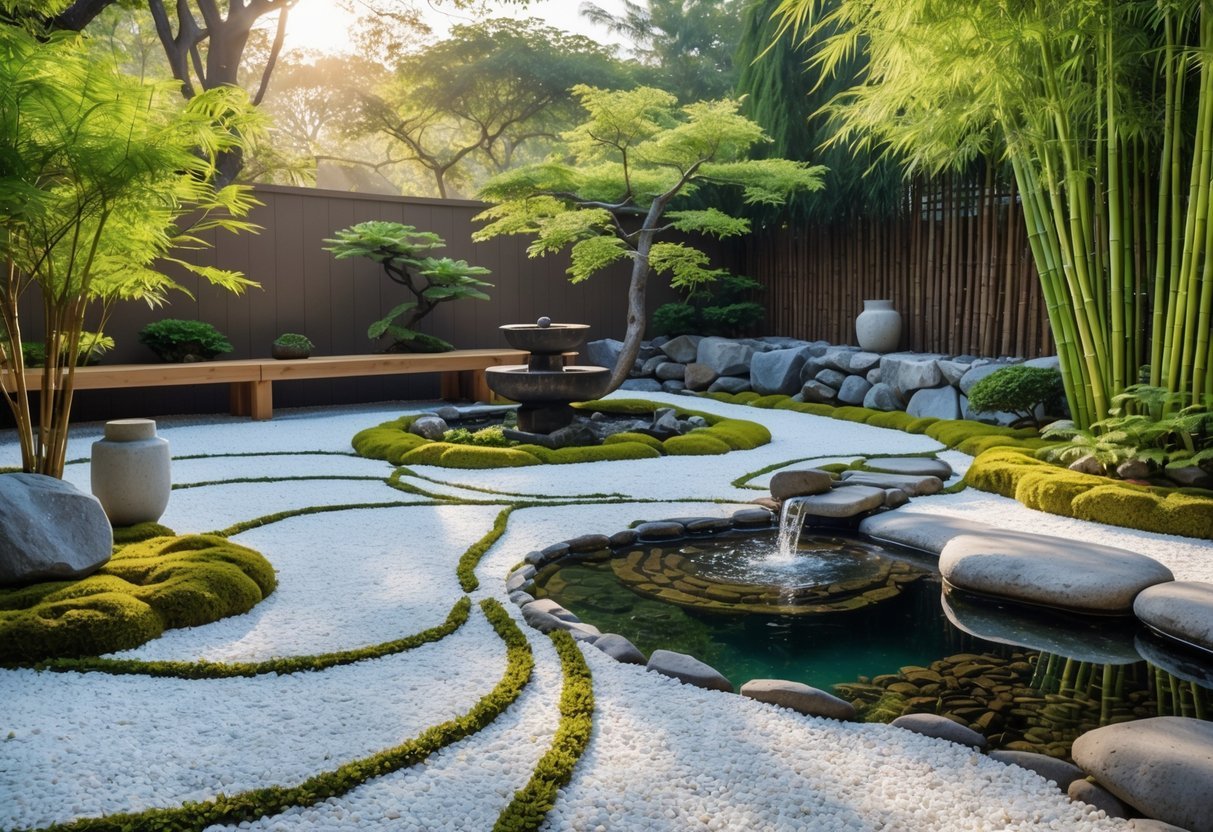
The tsukubai, a low stone basin fed by a bamboo spout, is one of the most recognized elements in Japanese garden design. In a backyard setting, it creates a soft, continuous sound of trickling water that masks street noise and signals that this space operates at a different pace than the rest of the day.
The basin sits low to the ground, traditionally at a height that required kneeling, symbolizing humility at the entry to a tea garden. For a residential backyard, a granite or concrete basin works well, with a short section of hollow bamboo angled to spill water in a gentle arc. A small submersible pump recirculates the water and requires nothing more than topping up the basin every few days.
Surround the basin with rounded river rocks and a patch of moss. Keep the planting tight and minimal: one small fern or a clump of Hakonechloa macra (Japanese forest grass) on the back edge is enough. This feature pairs well with zen rock garden ideas that use natural stone as the primary design material. Budget: $150 to $500 installed.
3. Moss and Stone Ground Cover Along a Fence Line
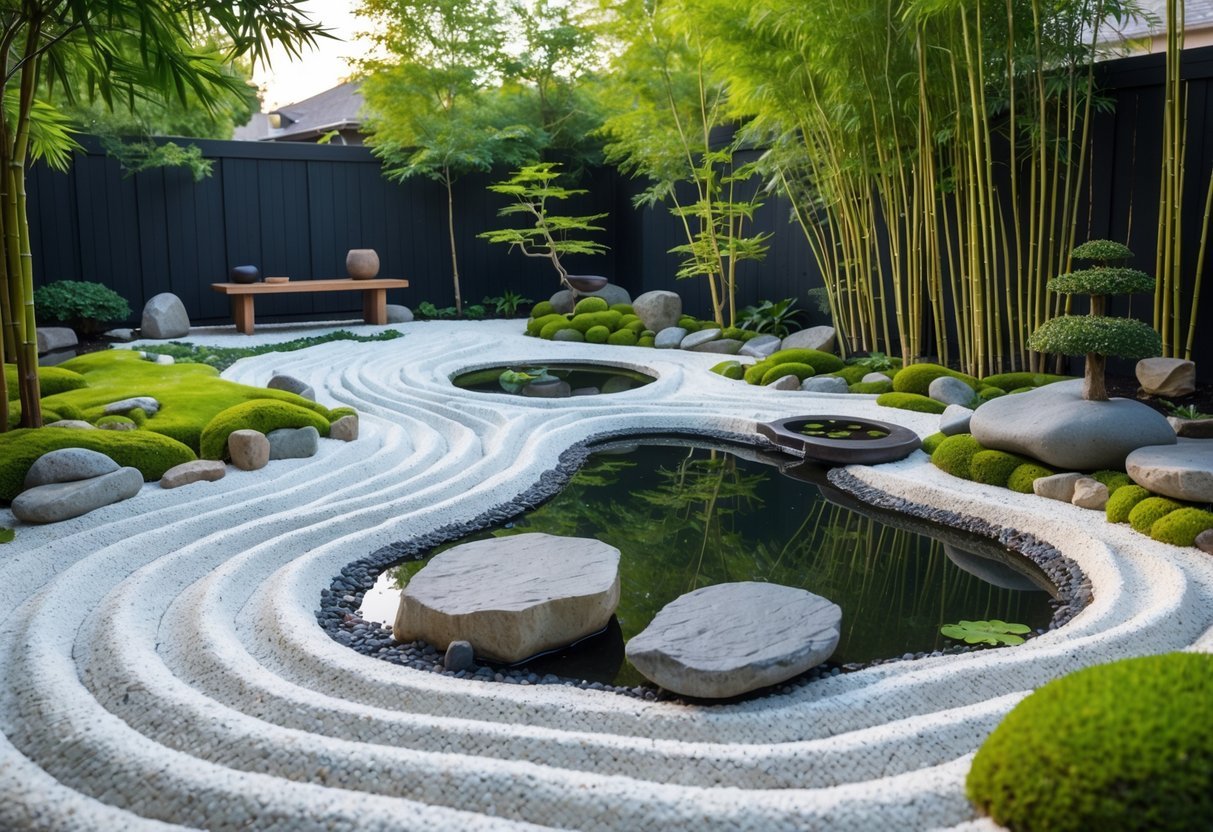
Replacing grass along a fence line with a moss and stone combination is one of the quietest and most effective zen garden transformations available. Moss needs almost no maintenance once established, absorbs sound, and creates a dense green carpet that ages beautifully around embedded stones.
Sheet moss or Irish moss both work well in partial shade, which is where most fence lines sit. Press the moss firmly into slightly acidic, moisture-retentive soil and keep it watered consistently for the first few weeks. Embed flat stones or irregular slate pieces at irregular intervals throughout the moss so the eye has somewhere to land. A few upright stones of varying heights near the back fence add vertical interest without requiring structural work.
This works especially well along the back fence of a narrow urban yard, where a grass strip is never lush enough to look intentional but takes real effort to maintain. The result feels like a living textile stretched between property lines. Budget: $100 to $300 depending on footage.
4. Japanese Maple as a Seasonal Focal Point
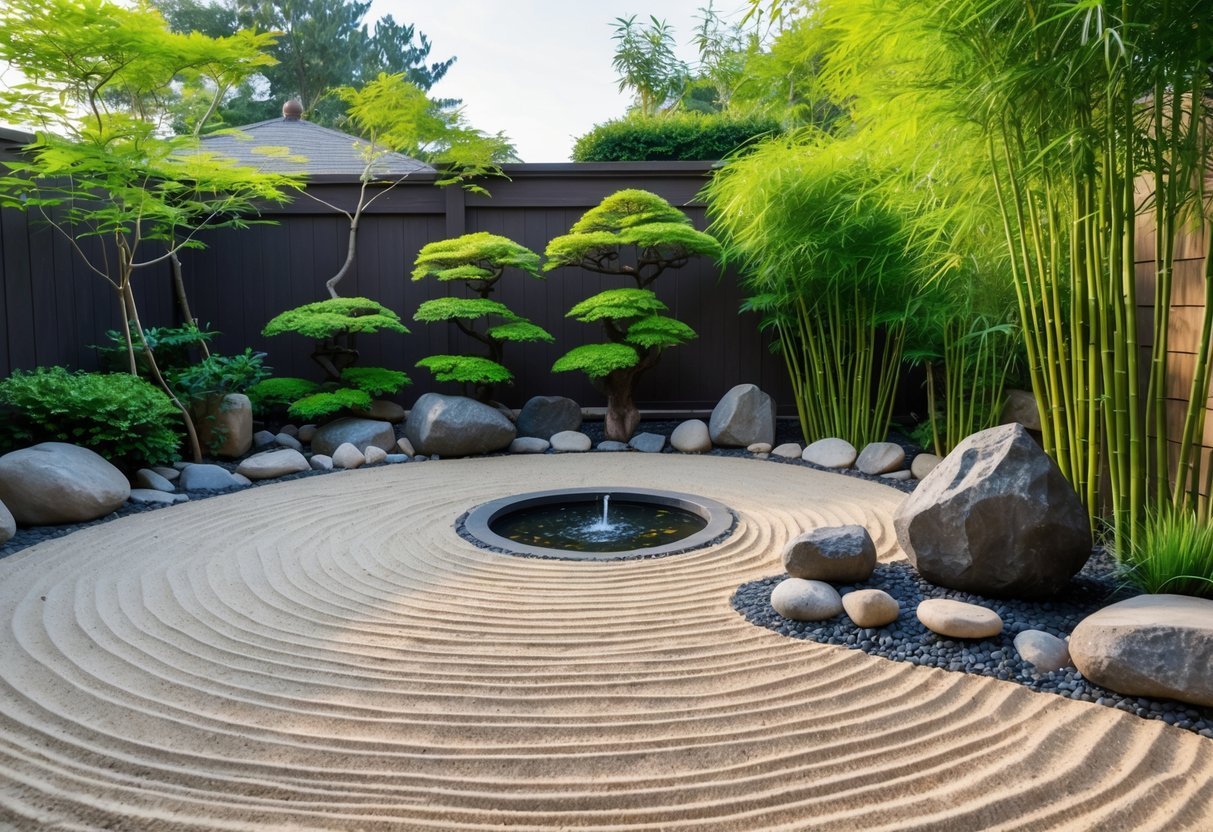
A Japanese maple (Acer palmatum) earns its place in a backyard zen garden because it changes with the seasons in the most graceful way possible. In spring the leaves open a pale chartreuse or deep burgundy depending on variety. Summer brings full, feathery foliage that catches every breeze. Autumn turns the whole tree amber, crimson, or orange, and in winter the bare branching structure reads as a natural ink drawing against the sky or a bamboo fence.
Placement matters. Set the tree slightly off-center in the garden, or at one end of a gravel bed where it anchors the composition without competing with the rake patterns. Dwarf weeping varieties like Acer palmatum ‘Crimson Queen’ stay under 8 feet and suit most residential spaces. Surround the base with river pebbles rather than mulch for a cleaner, more intentional look.
The maple is one element that benefits from an asymmetrical frame, which connects naturally to Japanese zen garden ideas rooted in the principle of fukinsei, the beauty of deliberate imbalance. Budget: $80 to $250 for a 3-gallon container plant, plus installation.
5. Gravel Bed With Irregular Stepping Stone Path
A path of irregular stepping stones set into a gravel bed does two things at once: it gives the garden a visual spine and it changes how you move through the space. You slow down when you pick your way along flat stones. That slowing down is the whole point.
Use natural flagstone, rough-cut slate, or large concrete pavers in a gray or charcoal tone. Space them at a natural walking pace, roughly 18 to 24 inches apart from center to center, and set them slightly lower than the gravel surface so raking flows over the edges. Irregular placement, slightly curved, feels more organic than a straight shot. A path that disappears slightly around a planted corner or behind a boulder creates a sense of mystery that’s central to zen garden design.
This layout works across an entire backyard or as a narrow connector between two zones, such as a gate and a meditation bench. Cedar, teak, or local stone benches at the path’s end give you a reason to complete the journey. Budget: $300 to $700 for materials across a 15-foot path.

6. Bamboo Privacy Screen for Enclosure
Zen gardens work best when they feel separated from the outside world, even slightly. A bamboo privacy screen on one or two sides of the garden creates that sense of enclosure without the heaviness of a solid fence. Light passes through bamboo. Wind moves through it and produces a soft, whispering sound. It ages from bright green to a warm amber-gold over a couple of seasons.
Bamboo panel fencing, available in pre-assembled rolls at most garden centers, installs on standard fence posts in an afternoon. For a more finished look, a cedar or teak frame with bamboo panels set into it reads more intentionally designed. If you want a living screen, clumping bamboo varieties like Fargesia rufa or Fargesia ‘Jiuzhaigou’ are non-invasive, reach 6 to 8 feet tall, and create a dense wall of vertical canes and rustling foliage.
Pair the screen with a gravel bed in front and a stone lantern or basin at the base for a composition that looks complete from the house or patio. This idea connects well with the full range of zen garden ideas that prioritize privacy and sensory separation from the street. Budget: $150 to $600 for panel fencing; $200 to $800 for living bamboo.
7. Stone Lantern for Nighttime Ambiance
A toro, the traditional Japanese stone lantern, is one of the most recognizable accents in zen garden design. Originally used to light the pathways of Buddhist temples and Shinto shrines, stone lanterns now serve as sculptural focal points that also extend the garden into evening hours.
The most common residential form is the pedestal lantern: a hexagonal or square head set on a single carved column, standing between 24 and 48 inches tall. Place it at a path intersection, beside a water feature, or at the edge of a gravel bed where it reads clearly against the open space. Real stone lanterns in granite or basalt are the most durable and authentic, but cast concrete versions age quickly and cost significantly less.
For actual light, a small LED candle insert or a solar-powered unit slipped into the lantern opening gives a warm, low glow that suits the meditative mood of the space. Keep surrounding plantings low so the lantern silhouette is visible at dusk. Budget: $80 to $400 depending on material and size.
8. Dry Riverbed Design With River Rocks and Boulders
A dry riverbed replicates the look of a natural stream using rock alone: no pump, no liner, no ongoing cost. The design uses large boulders along the outer edges, medium river rocks in the middle, and fine pebbles or smooth cobblestones to fill the path of the “flow.” The result looks like water passed through, receded, and left its record in stone.
The key to making a dry riverbed look convincing rather than decorative is to follow actual water logic. Water moves around obstacles, pools in low areas, and leaves finer sediment where the current slows. Arrange boulders on the curves, keep the center channel slightly recessed, and taper the riverbed to a natural end rather than stopping abruptly. Planting ornamental grasses, ferns, or a Japanese iris at the edges reinforces the idea that moisture once moved through this space.
This technique is particularly useful on a sloped backyard where erosion control is also a concern, and it pairs naturally with the stone-focused zen rock garden ideas that anchor many japandi outdoor spaces. Budget: $400 to $1,200 depending on rock sourcing and length of the riverbed.
9. Clumping Bamboo Grove for Height and Sound
Few plants change the atmosphere of a space as dramatically as bamboo. A grouping of clumping bamboo creates enclosure, height, movement, and sound all at once. The canes rattle softly in a breeze, the leaves flutter independently of each other, and the vertical lines pull the eye upward, making even a small backyard feel taller and more sheltered.
Always choose clumping varieties for a residential backyard: Fargesia rufa (cold-hardy down to USDA Zone 5), Fargesia nitida, or Borinda papyrifera for a more upright form. Running bamboo can escape into neighboring properties and cause serious problems. Set three to five clumps at the back or corner of the garden, allow them to grow together naturally over two or three seasons, and underplant with moss or black mondo grass (Ophiopogon planiscapus ‘Nigrescens’) for a finished base.
The bamboo grove works as a backdrop for raked gravel, a water feature, or a simple bench. It also provides year-round screening while remaining lightweight and visually open enough that the garden doesn’t feel boxed in. Budget: $50 to $120 per 3-gallon plant; plan for 3 to 5 plants per corner grouping.
10. Cedar Deck Floating Over a Gravel Border
A cedar deck set directly adjacent to or partially over a gravel bed creates an elegant transition between the functional outdoor living space and the meditative zen garden zone. The warm, golden tone of cedar contrasts beautifully with gray or cream gravel, and the horizontal lines of the decking boards create a visual calm that suits the overall aesthetic.
The design works by treating the deck as a platform from which the garden is viewed and experienced: you sit on the deck, your eye travels out over the gravel, takes in the stone arrangements, and rests. Built-in bench seating along the deck’s perimeter eliminates the need for outdoor furniture that would clutter the space. Composite decking in warm gray or brown tones is a lower-maintenance alternative that holds up better in wet climates.
Keep the gravel border at least 4 feet deep between the deck edge and the nearest fence or wall so the garden doesn’t feel cramped. Place a stone lantern or a specimen plant in the gravel to give the eye an anchor. This idea integrates naturally with mini zen garden concepts where a small defined zone does all the heavy visual lifting. Budget: $800 to $2,500 for deck construction depending on size and material.
11. Bonsai Display Area on Flat Stone Platforms
A dedicated bonsai display area turns the corner of a backyard into a living gallery. Flat stone slabs or low concrete platforms at varying heights give each tree its own stage, and the collection can grow or rotate across seasons without requiring any structural changes to the garden itself.
Choose a spot with good morning light and afternoon shade: most bonsai prefer at least four hours of direct sun but can scorch in the intense afternoon heat of summer. Set the platforms at different heights, staggering them so no single tree blocks another. Dwarf juniper, Japanese black pine, hornbeam, and Japanese maple are among the most popular bonsai species for outdoor display in temperate climates.
The gravel or stone surface beneath the platforms keeps the area tidy and reinforces the zen aesthetic. This display works especially well against a bamboo screen or a plain cedar fence, which provides a neutral backdrop that lets the tree forms read clearly. Add a low stone lantern at one end of the platform grouping to complete the composition. Budget: $200 to $600 for platforms and gravel; bonsai trees themselves range from $30 to several thousand dollars depending on age and training.
12. Raked Sand Meditation Corner
While crushed granite is more practical for most backyards, fine white sand in a contained meditation corner carries a purity and brightness that no other material matches. The act of raking it, drawing and redrawing patterns with a wide-toothed wooden rake, is itself the meditative practice. The garden changes every time, and nothing from yesterday’s stress survives.
Contain the sand in a raised wooden frame of cedar or pine, ideally 6 to 12 inches deep, with a clean edge that keeps the sand crisp and defined. The corner location creates two natural backing walls, which helps with enclosure. Set two or three stones in the sand, each placed at an angle that suggests it’s been there longer than the garden itself, and keep the surrounding planting to a minimum: one clipped boxwood sphere, a low ornamental grass, or nothing at all.
Reserve this space for early mornings before the day begins or evenings after it ends. It’s a reset button, not a decoration. Pair it with a comfortable low seat, ideally a simple teak bench or a flat granite slab, positioned so you can sit and look across the sand without having to look into the sun. Budget: $150 to $350 for the frame, sand, and stones.
13. Koi Pond With Gravel Surround and Planting Edges
A koi pond transforms a backyard zen garden from a still composition into a living one. The movement of fish through clear water, the sound of a small waterfall or skimmer, and the reflection of sky and trees on the surface all add a sensory richness that purely dry gardens cannot match. Koi are also surprisingly interactive: they learn to come to the surface at feeding time, which creates a meditative ritual of its own.
A residential koi pond needs to be at least 2 feet deep to protect fish from predators and temperature extremes, and ideally 3 feet in colder climates. A pond pump with biological filtration keeps water clear without chemicals. Edge the pond with irregular flagstone set at water level, and use river cobblestones in the gravel surround to extend the stone palette naturally beyond the water’s edge.
Keep pond planting restrained: a single water iris, a few marginal rushes, or floating water lotus add structure without turning the pond into a wildlife pond. The koi themselves provide all the color and movement the space needs, which connects well to zen garden ideas that prioritize one strong focal element over visual complexity. Budget: $800 to $3,000 for a basic 8×10 foot pond with pump and filtration.
14. Rock Garden With Dwarf Conifers and Ornamental Grass
A rock garden built around dwarf conifers and ornamental grasses gives a backyard zen garden strong year-round structure without requiring a single flower. The conifers provide permanent form: pyramidal, globose, spreading, or weeping shapes that look intentional even in February when everything else is dormant.
Choose a selection of three to five conifer varieties that contrast in form: a dwarf mugo pine (Pinus mugo ‘Mops’) for a low, rounded mass; a Hinoki cypress (Chamaecyparis obtusa ‘Nana Gracilis’) for vertical textural interest; a spreading juniper for ground-level coverage. Interplant with clumps of Japanese forest grass (Hakonechloa macra) whose arching blades and golden fall color add softness to the harder evergreen forms.
Bury large stones deep enough that they look as if they emerged naturally from the ground rather than being placed on top of it. A stone buried one-third of its mass looks anchored; one sitting on the surface looks deposited. Surround with a fine gravel mulch rather than bark to keep the aesthetic coherent. This design holds up especially well in colder climates where other zen garden plants struggle. Budget: $400 to $1,000 for plants, stone, and gravel.
15. Vertical Slatted Cedar Wall as a Garden Backdrop
A vertical slatted cedar wall does for a backyard zen garden what a gallery wall does for a room: it provides a clean, neutral plane against which every other element reads more clearly. The gaps between slats allow air movement and some transparency, so the wall feels architectural rather than prison-like.
Build the wall from 1×4 or 1×6 cedar boards set on a pressure-treated frame, with a gap of one-half to one inch between each board. Cedar’s natural oils resist rot and insects without any treatment, and the wood weathers from bright blonde to a warm silver-gray over two or three seasons. Mount a stone lantern or a wall-mounted bamboo spout on the face of the wall to integrate water or lighting without adding freestanding elements.
The wall works especially well in smaller backyards where a solid fence would create a claustrophobic enclosure but an open chain-link fence would destroy the sense of sanctuary. Place the gravel bed immediately in front of the wall, leaving a gap of 12 to 18 inches for planting a single dwarf conifer or clipping a boxwood into a simple geometric form. Budget: $600 to $1,800 for a 10-foot section depending on height and material quality.
16. Shishi-Odoshi Deer Chaser Water Feature
The shishi-odoshi, literally “deer chaser,” is a pivoting bamboo tube that fills with water from a spout, tips when full, empties with a sharp knock against a stone, and returns to its upright position. The intermittent rhythm of that knock is unlike any other garden sound: startling the first time, then deeply familiar, then something the ear begins to anticipate.
Traditional versions were installed in Japanese gardens to keep deer and boar from eating plants. In a residential backyard they serve as an ambient sound feature that works in cycles, filling, tipping, knocking, refilling, every 30 to 90 seconds depending on water flow rate. A small recirculating pump and a simple reservoir hidden beneath river cobblestones keeps the system running with minimal maintenance.
Set the shishi-odoshi against a bamboo screen or a cedar wall so the knock resonates clearly. Surround the basin and reservoir with rounded river rocks and a cushion of moss. Keep the plantings around it very simple: this feature performs best as a solo act with space around it. This pairs beautifully with the water-focused elements in Japanese zen garden ideas where sound is considered as deliberately as visual design. Budget: $200 to $600 for a quality kit plus pump and reservoir.
17. Simple Gravel Courtyard With Concrete Pavers
For backyards with a contemporary or japandi architectural style, a gravel courtyard defined by large concrete pavers offers a more modern interpretation of zen garden principles without any traditional ornamentation. The palette is minimal: concrete gray, gravel gray, and the occasional dark green accent plant.
Set large-format concrete pavers in a grid or offset pattern across the gravel bed, leaving gravel gaps between each one. The gravel fills in naturally and the pavers create a coherent ground plane that reads as designed rather than improvised. A single specimen plant, a clipped boxwood sphere, an ornamental grass clump, or a Japanese black pine, placed at one side of the courtyard, provides the only break from the hardscape geometry.
The concrete paver courtyard suits smaller backyards where a full gravel bed with raked patterns would be impractical to maintain. It also works as a zero-lawn solution for low-water landscapes in dry climates. Keep the fence or boundary simple: horizontal cedar slats, white stucco, or black steel mesh all work well as backdrop. Budget: $500 to $1,500 depending on paver size and coverage area.
18. Compact Corner Zen Garden Under 6×6 Feet
Not every backyard zen garden needs to take over the whole yard. A 6×6 foot corner, tucked against a fence with a bamboo screen and a gravel tray, creates a complete and convincing zen space that costs under $300 and takes a weekend to install.
Define the corner with two sections of bamboo fencing mounted on the existing fence posts. Fill the ground with landscape fabric topped by 3 inches of fine gravel. Place a single medium-sized stone as an anchor. Add a small stone lantern or a tsukubai basin if the budget allows, or keep it even simpler: just stone, gravel, and one dwarf conifer in a terracotta or concrete pot.
The size constraint is an advantage. A small zen corner doesn’t require hours of maintenance, doesn’t compete visually with the rest of the garden, and gives you a defined place to focus your attention when you sit nearby. It can be a starting point that expands over time, or a permanent feature that never needs to be more than what it is. This approach is exactly what makes mini zen garden design so accessible regardless of yard size. Budget: $150 to $300.
19. Meditation Bench and Winding Stone Path
A backyard zen garden without a place to sit is a garden you pass through rather than inhabit. A simple meditation bench at the end of a winding stone path gives the space a destination and changes how you relate to the rest of the design: now you’re sitting inside it instead of looking at it from the patio.
The bench itself should be simple: a thick slab of cedar or teak on two low supports, wide enough to sit comfortably in crossed-leg meditation posture, and low enough that the eye stays close to the gravel and stone level of the garden. Set it so it faces the most considered view in the garden: the raked gravel bed, the water feature, or a carefully placed specimen plant.
The path leading to the bench should curve gently rather than run straight, so the approach feels like a transition. Use flat irregular stones or concrete pavers in the same tone as the bench surround. This destination-driven design connects naturally with the zen garden ideas where human use of the space, not just its visual appeal, guides every design decision. Budget: $200 to $500 for bench and path materials.
20. Buddha or Ishi-doro Stone as a Garden Focal Point
A stone sculpture, whether a seated Buddha figure, an abstract carved form, or a traditional ishi-doro lantern, gives a backyard zen garden a single strong focal point that the rest of the design can orient around. The eye needs somewhere to land, and a well-placed sculpture earns that role without demanding visual complexity.
Position the sculpture slightly off-center in the garden rather than dead center, which would feel static. Place it at the back edge of a gravel bed, where it reads clearly against a bamboo screen or cedar fence backdrop. Seat it on a flat stone plinth rather than directly on the ground to raise it enough to be visible but not so high that it loses its connection to the earth.
Surround the base with a tight circle of river pebbles or moss to frame the piece and distinguish it from the surrounding gravel. Keep everything else in the garden lower so the sculpture’s silhouette stays dominant. This works in any style of zen garden, traditional or contemporary, and suits every budget: cast concrete Buddhas start at $40, while carved granite pieces run several hundred dollars. Budget: $40 to $500 depending on material and scale.
21. Evening Low-Voltage Lighting Around Stones and Gravel
The right lighting extends a backyard zen garden into the hours after dark and completely transforms how the space reads. Low-voltage path lighting aimed at gravel casts the rake patterns into sharp relief as the shadow from each line deepens under the oblique light angle. Uplighting behind a boulder or beneath a Japanese maple makes the garden look like a stage set, but a very quiet one.
Use warm white bulbs in the 2700K range, never cool white or daylight temperature LEDs, which read as clinical and hard in a space that depends on warmth and softness. Pathway fixtures in weathered bronze or matte black disappear into the landscape. Hidden spotlights buried near specimen plants or boulders should aim across the subject at a low angle rather than straight up, which creates modeling and depth rather than flat illumination.
Keep the lighting sparse: three to five fixtures in a modest garden are enough. The goal is to make the garden readable and welcoming after dusk, not to flood it with brightness. This final layer of design pays off every evening for the life of the garden, and low-voltage LED systems are inexpensive to run. Budget: $200 to $600 for a quality low-voltage system with six to eight fixtures. Visit zeninhome.net for more outdoor design ideas that bring calm into everyday spaces.
Design Tips for Backyard Zen Gardens
Start with the ground plane and work upward. Gravel, stone, or moss laid first establishes the palette for everything else. Choose one base material and commit to it: mixing multiple ground textures too early fragments the calm you’re trying to build. Lay woven landscape fabric beneath gravel before you place a single stone, because removing gravel to fix weed problems later is the most common maintenance frustration in zen garden design.
Scale your elements to your yard. Large boulders that look commanding in a 30-foot space overpower a 10-foot corner. Conversely, small stones and fine gravel get lost in a large yard. Bring a photo of your space when sourcing stone at a landscape yard and hold pieces against each other to gauge proportion before buying.
Restrain the plant palette to three or four species maximum. One tree, one shrub, one groundcover, one grass. Repetition and restraint read as intention; variety reads as indecision. Choose plants primarily for form and foliage texture rather than for flower color, which blooms briefly and then leaves a gap. Slow-growing evergreens that hold their shape year-round are worth their higher price over faster-growing plants that require constant trimming to stay tidy.
Maintain sight lines. The most calming views in a zen garden are unobstructed: you should be able to see from your seating position across the full gravel area or water feature to the boundary of the garden. Tall plants belong at the edges, not scattered through the center. When in doubt, take something out rather than adding more.
Common Mistakes to Avoid With Backyard Zen Gardens
Overcrowding the space. The biggest error in home zen garden design is adding too much. Every decorative stone, every plant, every light fixture competes for attention. Zen design is built on negative space: the empty areas are as important as the filled ones. If you find yourself adding more to fill a gap, stop and look at what’s already there. The gap may be intentional.
Using the wrong gravel depth. Gravel laid too shallow, under 2 inches, won’t hold rake patterns and shifts easily underfoot. It also allows weeds to establish faster. Go 3 to 4 inches deep for rake-friendly, weed-resistant results. Skipping landscape fabric beneath is the second part of this mistake: even the best gravel bed becomes weed-filled within two seasons without it.
Placing plants through the center of the gravel bed. Plants growing up through raked gravel interrupt the flow of the design and make raking around them tedious. Keep planted areas at the edges of the gravel, in defined borders or raised sections, and maintain the center as a clean, open ground plane.
Installing running bamboo. Running bamboo spreads aggressively through underground rhizomes and can cross property lines within a few seasons. Always use clumping varieties for residential gardens. If running bamboo is already in place, rhizome barriers need to be installed before the plant becomes a significant problem for neighboring properties.
Choosing lighting that’s too bright. High-lumen floodlights aimed at a zen garden destroy its atmosphere. The goal at night is to create gentle visual interest, not visibility. Warm, dim, directional fixtures that pick out specific stones or plants while leaving shadows in between are always the right choice.
Ignoring drainage. Gravel in a low-lying area without adequate drainage becomes a puddle after heavy rain. Assess the drainage before you begin and add a slight grade away from structures, or install a gravel drainage layer beneath the landscape fabric, to keep the garden dry and the rake patterns intact after rainfall.
Check These Related Ideas
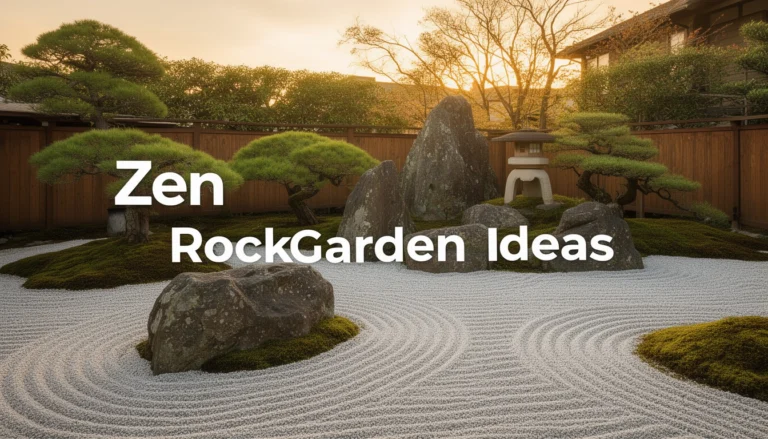
- zen rock garden ideas
- Japanese zen garden ideas
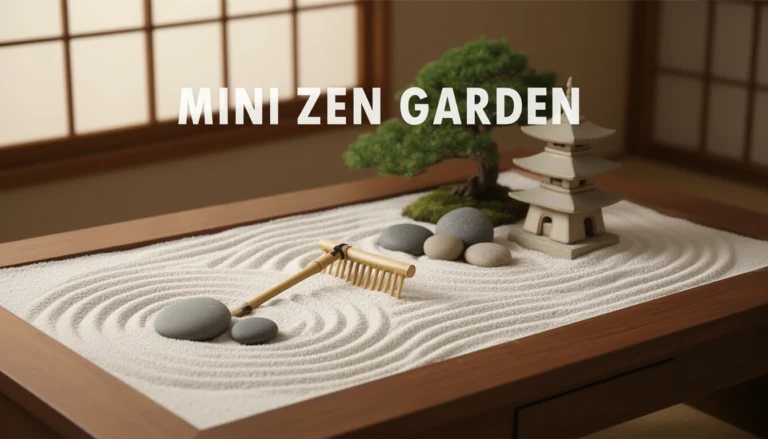
- mini zen garden ideas
- zen garden ideas
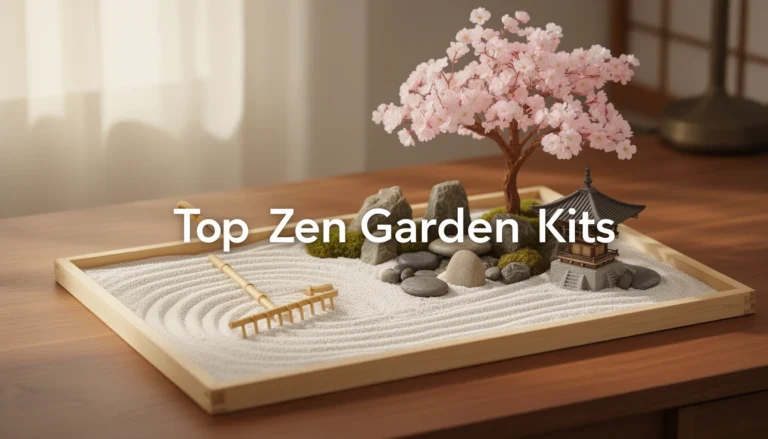
- top zen garden kits
A backyard zen garden doesn’t need a large budget or a professional landscaper to get right. Start with one element, a small gravel bed, a single stone lantern, a compact corner enclosed by bamboo screening, and let the space tell you what it needs next. The best zen gardens grow slowly, with intention, and they improve every time you take something away rather than add more.
Pick the one idea from this list that fits your yard as it is right now, not the yard you might have someday. Get that one thing right, sit in front of it for a few evenings, and notice what shifts. That shift is what the whole practice is about.
Frequently Asked Questions
How much does a backyard zen garden cost?
A basic backyard zen garden costs $300 to $800 using gravel, a few stones, and landscape fabric. Larger designs with water features or bespoke stonework can run $2,000 to $8,000 or more.
Can I make a backyard zen garden in a small space?
Yes. Even a 6×6 foot corner works well. Use a gravel tray, two or three stones, a dwarf conifer, and bamboo screening to create a complete sense of enclosure and calm.
What gravel is best for a zen garden?
Crushed granite, pea gravel, or fine decomposed granite are the top choices. Light gray or cream tones rake cleanly and hold patterns well. Avoid colored or painted gravel.
Do zen gardens require a lot of maintenance?
No. Raking gravel once or twice a week keeps the patterns fresh. Weeding is minimal with landscape fabric beneath the gravel. Plant trimming and stone cleaning are the main seasonal tasks.
What plants work best in a backyard zen garden?
Dwarf pines, Japanese maples, moss, boxwood, ferns, and clumping bamboo all suit the zen aesthetic. Choose slow-growing, low-maintenance species that provide year-round texture.
Do I need a water feature in a zen garden?
Not at all. Traditional karesansui gardens use raked gravel to symbolize water. A bamboo tsukubai basin or a simple recirculating fountain can add sound, but neither is required.
How do I keep weeds out of my zen garden gravel?
Lay a high-quality woven landscape fabric before adding gravel. Keep gravel 3 to 4 inches deep. Pull any weed seedlings early before roots establish, and rake regularly to disrupt them.